
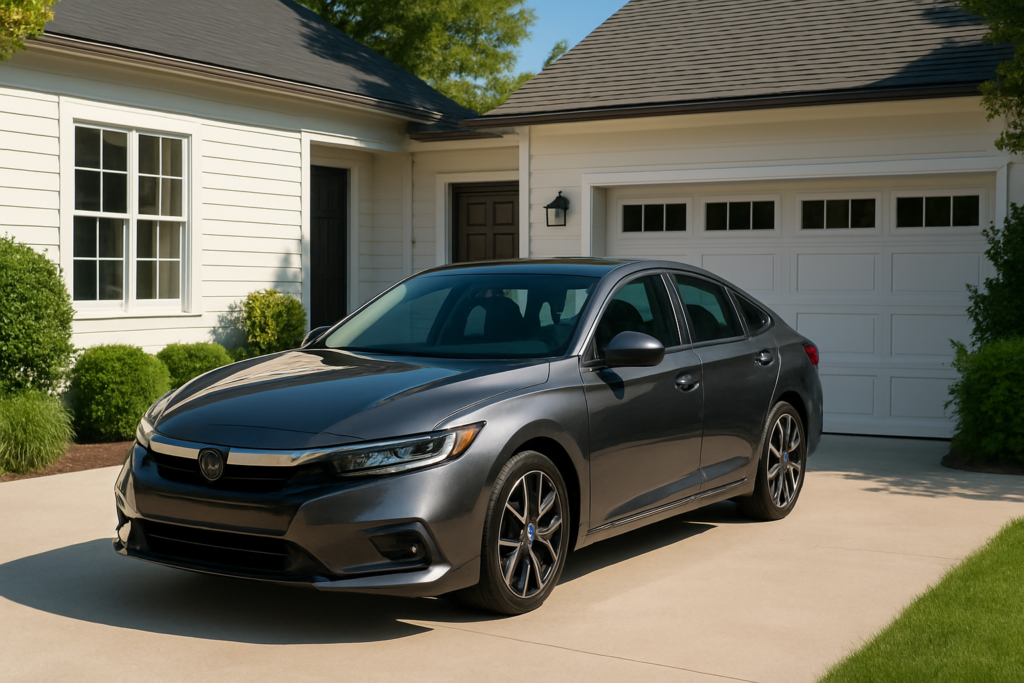
The car payment is one of the most underestimated expenses in an American household budget. Not because people don't know what they're agreeing to pay monthly — they do — but because most people budget the monthly payment in isolation and ignore the full cost picture: insurance, depreciation, maintenance, opportunity cost of the down payment, and how the car payment interacts with other financial goals. When you add everything up, a $28,000 new car on a $55,000 salary isn't a $519/month decision. It's closer to a $649-680/month decision once insurance is included, and it consumes 14-15% of gross monthly income — a level most financial planners consider a strain on a household budget that also needs to fund rent or a mortgage, food, retirement savings, and everything else.
This isn't an argument against buying a car or even against buying new. It's an argument for doing the full math before signing, because the total cost difference between a new $28,000 car and a reliable used $18,000 car over five years of ownership is approximately $12,000-15,000 — money that can fund a meaningful portion of an emergency fund, a Roth IRA contribution, or a down payment fund depending on where you are in your financial life.
The 20/4/10 Rule: The Starting Point for Car Affordability
Financial planners have long used variations of the 20/4/10 rule as a car affordability guideline:
20: Put at least 20% down
4: Finance for no longer than 4 years (48 months)
10: Keep total monthly car costs (payment + insurance) at or below 10% of gross monthly income
These numbers aren't arbitrary. The 20% down payment prevents being 'underwater' on the loan — when you owe more than the car is worth — which happens quickly to new car buyers who finance 100% because new cars depreciate 15-20% in the first year. The 4-year term limits total interest paid and forces a reality check on whether the car is actually affordable at an accelerated payoff pace. The 10% cap on total car costs protects housing, food, savings, and debt payoff goals from being crowded out.
Applied to a $55,000 salary:
Monthly gross income: $4,583
10% guideline: $458/month maximum for payment + insurance combined
New $28,000 Car: The Full Monthly Math
Loan Calculation
A new $28,000 car with 20% down ($5,600) leaves a $22,400 loan. At current new car loan rates for good-credit borrowers (approximately 5.5-6.5% APR in 2024), a 48-month loan produces:
At 5.5% APR (excellent credit, 760+): $519/month
At 6.5% APR (good credit, 700-760): $531/month
At 8.5% APR (average credit, 660-700): $552/month
Total interest paid over 4 years (at 5.5%): approximately $2,512
Total principal + interest paid: $24,912
Insurance Cost
A new vehicle requires comprehensive and collision coverage — lenders mandate this as a condition of the loan. For a new $28,000 car driven by a typical 25-40-year-old with a clean driving record, comprehensive + collision insurance averages $130-165/month nationally, with significant variation by state (Texas, Florida, and Michigan are notoriously expensive; rural Midwest states tend to be cheaper).
Conservative estimate: $150/month in insurance
Total Monthly Cost of a New $28,000 Car
Payment (5.5% APR, 48 months): $519/month
Insurance: $150/month
Total: $669/month
As percentage of $55,000 salary gross monthly income ($4,583): 14.6%
The new $28,000 car exceeds the 10% guideline by 46% — consuming nearly 15 cents of every gross dollar earned on just the car. This before any other debt payment, housing cost, retirement contribution, or savings goal.
Used $18,000 Car: The Full Monthly Math
What $18,000 Buys in the Used Market
In 2024, $18,000 with a 20% down payment covers a wide range of reliable used vehicles with 35,000-70,000 miles. Representative options: 2020-2021 Honda Civic, 2019-2020 Toyota Corolla, 2019-2021 Mazda3, 2018-2019 Honda CR-V or Toyota RAV4, 2020 Hyundai Elantra. These are not compromise vehicles — they're the models that routinely appear at the top of reliability rankings and routinely run 200,000+ miles with normal maintenance. The used car penalty in terms of quality is essentially zero for buyers willing to do basic research and a pre-purchase inspection.
Loan Calculation
$18,000 with 20% down ($3,600) leaves a $14,400 loan. Used car loans carry slightly higher rates than new car loans:
At 6.5% APR (good credit): $341/month over 48 months
At 8.0% APR (average credit): $352/month over 48 months
At 10.5% APR (fair credit): $371/month over 48 months
Total interest paid over 4 years (at 6.5%): approximately $1,968
Total principal + interest paid: $16,368
Insurance Cost
A 3-year-old used vehicle still requires comprehensive and collision coverage while the loan is active, but the lower vehicle value translates to lower insurance premiums. Typical insurance for a $18,000 used vehicle: $100-130/month.
Conservative estimate: $115/month in insurance
Total Monthly Cost of a Used $18,000 Car
Payment (6.5% APR, 48 months): $341/month
Insurance: $115/month
Total: $456/month
As percentage of gross monthly income: 9.9% — just inside the 10% guideline
The 4-Year and 5-Year Total Cost Comparison
Out-of-Pocket Cash Over 4 Years (Loan Period)
New $28,000 car:
Down payment: $5,600
48 months of payments: $519 × 48 = $24,912
48 months of insurance: $150 × 48 = $7,200
Maintenance (mostly covered by warranty): ~$1,200
4-year total out-of-pocket: $38,912
Used $18,000 car:
Down payment: $3,600
48 months of payments: $341 × 48 = $16,368
48 months of insurance: $115 × 48 = $5,520
Maintenance (partial warranty + normal upkeep): ~$2,400
4-year total out-of-pocket: $27,888
4-year difference: $11,024 — the new car costs $11,024 more over 4 years
The Depreciation Factor
After 4 years, the new $28,000 car has depreciated to approximately $14,000-17,000 (50-60% of original value is typical for mainstream vehicles at 4 years/50,000 miles). The used $18,000 car (now 7 years old) has depreciated to approximately $9,000-11,000.
Net depreciation hit:
New car: Bought at $28,000, worth ~$15,500 after 4 years = $12,500 depreciation loss
Used car: Bought at $18,000, worth ~$10,000 after 4 years = $8,000 depreciation loss
Depreciation difference: $4,500 more depreciation on the new car
Combined out-of-pocket plus depreciation over 4 years:
New car: $38,912 cash + $12,500 depreciation = $51,412
Used car: $27,888 cash + $8,000 depreciation = $35,888
Total 4-year cost difference: $15,524 in favor of the used car
When Buying New Actually Makes Sense
The used car wins the pure math comparison on a $55,000 salary. But new cars aren't irrational in every scenario:
You plan to keep the car 10+ years. The depreciation penalty on a new car is front-loaded — it's worst in years 1-3. A buyer who keeps a new car for 10-12 years spreads the depreciation hit over a much longer period and benefits from the full manufacturer warranty, the latest safety technology, and no pre-existing mechanical history. The longer the ownership period, the more the new car argument improves.
You have a specific configuration need. If you need a particular trim level, color, feature package, or accessible vehicle configuration that isn't available in the used market, new is the only option. The new car premium is the price of getting exactly what you need.
The manufacturer incentive math works. When manufacturers offer 0% APR financing (which they do periodically on popular models), the 'interest penalty' of buying new disappears. A $28,000 car at 0% APR for 48 months costs exactly $28,000 in loan payments — which changes the comparison entirely. Watch for these offers, particularly at end-of-model-year clearances in August-October.
You're driving high miles in a demanding environment. A new vehicle with a full manufacturer's warranty is more defensible if you're putting 25,000+ miles/year on it, live in a region with harsh weather, or need the reliability guarantee for a long-distance commute with no margin for breakdowns.
The Opportunity Cost: What $11,000 Does If Invested Instead
The $11,024 difference in 4-year out-of-pocket cost between the new and used car has a second-order financial impact that most buyers never calculate. That $11,000, invested in a broadly diversified index fund earning the historical market average of 7% annually, grows to approximately $15,400 over 4 years and $21,500 over 7 years. For someone in their late 20s or early 30s, $11,000 invested at 30 reaches approximately $84,000 by age 60 (30 years at 7%). The decision to buy a new $28,000 car instead of a reliable used $18,000 car isn't just a $11,000 decision — it's a $84,000 decision measured against retirement savings, depending on your age and investment timeline.
The Consumer Reports car buying guide provides the reliability data, depreciation curves, and true cost of ownership tables for specific makes and models that turn 'used car research' from a guessing game into a specific comparison — particularly useful when choosing between 3-4 used models in the $15,000-20,000 range.
Practical Tips for Buying a Used Car Without Getting Burned
Get a pre-purchase inspection. Any independent mechanic (not the dealership) will inspect a used vehicle for $100-150. This is non-negotiable. A pre-purchase inspection on a $18,000 car that uncovers $4,000 in needed repairs has paid for itself 40x over.
Run the VIN history. Carfax or AutoCheck reports ($40-50) show accident history, ownership count, title status, and service records. A clean Carfax doesn't guarantee a perfect car, but a messy Carfax is a red flag worth heeding.
Buy at the end of the month. Dealerships work against monthly sales quotas. A salesperson who needs two more units to hit bonus at month-end on the 29th is more negotiable than the same salesperson on the 5th.
Finance through your bank or credit union before going to the dealer. Come in with a pre-approved loan rate. The dealer's finance office can sometimes beat it, but you negotiate from a position of strength rather than being dependent on whatever rate the dealer offers.
A personal finance guide covering major purchases walks through the car, house, and student loan decisions together as part of a coherent lifetime financial strategy — helpful for anyone in their 20s and 30s facing multiple large financial decisions simultaneously rather than in isolation.
The Bottom Line on $55,000 and a Car Purchase
On a $55,000 salary, the 10% guideline ($458/month) is tight. A new $28,000 car simply doesn't fit under that number once insurance is included — it runs 14-15% of gross income and leaves less room for housing cost fluctuations, retirement contributions, or financial emergencies. A used $18,000 car with 20% down fits the guideline at 9.9% and delivers nearly identical transportation value for most commuting and errand use cases.
The new car isn't wrong if you have the income to support it comfortably — the 10% rule is a guideline, not a law. But on a $55,000 salary where a new $28,000 car becomes 14-15% of gross income, the financial pressure is real, and the $11,000-15,000 four-year cost difference is a meaningful sum. A used car negotiation guide helps bridge the knowledge gap between what the dealership knows about pricing and what a first-time used car buyer knows — and that gap is typically worth several hundred to several thousand dollars at the negotiation table.
Related reading: passive income, saving for a house, and building an emergency fund.
The best car decision is the one that gets you reliable transportation, fits your actual budget without straining other financial goals, and allows you to keep making progress on savings and debt payoff simultaneously. On most $55,000 salaries, a clean used car in the $15,000-20,000 range does all of that. A new $28,000 car forces trade-offs that compound over time.