
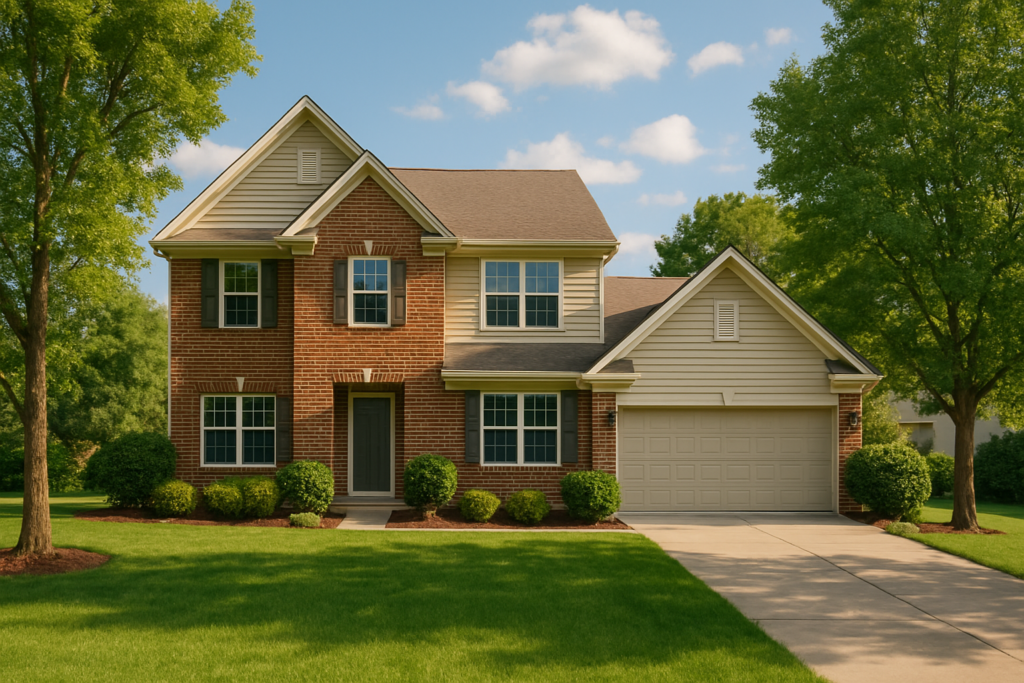
Here’s something most homeowners never think to check: the amount of coverage on their homeowners insurance policy has almost nothing to do with how much it would actually cost to rebuild their house if it burned down tonight. The policy was set when you bought the home. The home’s market value went into the coverage number. And the market value includes the land beneath the house — land that doesn’t need to be rebuilt. Meanwhile, construction costs have climbed. Your coverage hasn’t kept up. You’re probably underinsured, and you have no idea.
This isn’t a horror story. It’s a math problem. And the good news is it takes about 30 minutes to fix.
The Number That Actually Matters: Replacement Cost
When something goes wrong — a house fire, a severe hail storm, a tree through your roof — your homeowners insurance pays to rebuild or repair based on the replacement cost of your dwelling, not its market value. These two numbers are often very different.
Market value = what you’d sell the property for, including the land it sits on. Replacement cost = what it would cost in labor and materials to rebuild the physical structure from the ground up.
Land doesn’t burn. Land doesn’t flood. Land doesn’t need to be reconstructed after a fire. If you bought a house for $280,000 in a neighborhood where the land itself is worth $70,000, your actual rebuilding exposure is roughly $210,000 — but that’s not how most policies get set. Many insurers use the purchase price as a starting point, which inflates the perceived coverage while potentially still leaving you short on the rebuilding math.
And here’s the real problem: construction costs move. A policy set five years ago based on $120 per square foot to rebuild may now face actual costs of $160 or $175 per square foot in your area. A 1,800-square-foot home at today’s rebuild costs in many markets runs $290,000 to $315,000. If your dwelling coverage is $250,000 because that’s where it was set when you closed, you’re exposed to a six-figure gap if you ever have to make a total-loss claim.
The Four Things Homeowners Insurance Actually Covers
Most homeowners think of their policy as "house insurance." It’s actually four separate types of protection bundled into one premium:
Dwelling coverage (Coverage A): This is the big one — what it costs to rebuild your physical home if it’s destroyed. This should equal your home’s replacement cost, not its market value or purchase price.
Personal property coverage (Coverage C): Your furniture, appliances, electronics, clothing, tools, and everything else inside the home. Standard policies typically set this at 50-70% of your dwelling coverage. On a $280,000 dwelling policy, that’s $140,000 to $196,000. Most people’s actual belongings are worth significantly less than that — but some households exceed it without realizing it (a few pieces of decent furniture, two newer cars’ worth of electronics, decent jewelry, and kitchen equipment adds up faster than people expect).
Liability coverage: This is the part most people dramatically underinsure. If someone is injured on your property — a guest slips on your icy stairs, a neighborhood kid falls off your deck — and they sue you, your liability coverage pays for their medical bills, your legal defense, and any judgment against you. The standard minimum is $100,000. That’s not enough. One serious injury requiring surgery, hospitalization, and physical therapy can easily exceed $100,000 before a lawsuit is even filed. I’d argue $300,000 is the practical minimum for anyone who owns a home, hosts guests regularly, or has a dog. More on that in a moment.
Additional living expenses (Coverage D): If your home is uninhabitable during repairs, this covers your hotel, meals, and other costs while you’re displaced. People forget this exists until they need it, at which point they’re very glad it’s there.
Replacement Cost vs. Actual Cash Value — Don’t Get This Wrong
for personal property coverage, there are two very different ways insurers pay claims.
Replacement cost coverage: They pay what it costs to buy a comparable new item today. Your five-year-old laptop gets replaced with a current equivalent laptop.
Actual cash value (ACV): They pay the depreciated value of the item — what your five-year-old laptop is worth as a used five-year-old laptop. That’s often 20-40% of what a replacement costs.
Always choose replacement cost coverage for personal property. The premium difference is usually $50 to $100 a year. The claims difference can be thousands of dollars. This is the same principle as renters insurance — you can read more about how replacement cost coverage works compared to actual cash value and why it’s worth the small premium difference.
Is $1,200 a Year Too Little for a $280,000 House?
Maybe. Maybe not. It depends on what that $1,200 is buying you.
A $1,200 annual premium on a $280,000 house could represent excellent coverage — high dwelling limits, replacement cost on personal property, $300,000 in liability — achieved through good discounts, a newer roof, a clean claims history, and competitive shopping. That’s a great outcome.
A $1,200 annual premium could also represent a policy that was deliberately stripped down to hit a monthly payment target: low dwelling coverage, actual cash value on personal property, the $100,000 liability minimum. That’s a budget premium on inadequate coverage.
The dollar amount of your annual premium tells you almost nothing without knowing what it covers. Pull your declarations page — the one-page summary at the front of your policy — and look at four specific numbers:
- Coverage A (Dwelling): Does it match or exceed your home’s current replacement cost?
- Coverage C (Personal Property): Is it on a replacement cost basis or actual cash value?
- Liability: Is it at least $300,000?
- Your deductible: Higher deductibles = lower premiums, but make sure you can actually afford to pay it if you file a claim.
How to Figure Out Your Actual Replacement Cost
The fastest method: ask your insurer to run a replacement cost estimator on your home. Most major carriers have a tool that calculates rebuild cost per square foot based on your home’s size, construction type, age, roof material, and local labor costs. This should be free. Request it at your next renewal.
The DIY method: look up current construction costs in your area (a local contractor can ballpark this) and multiply by your home’s square footage. A 1,600-square-foot home in the Midwest might rebuild at $140-$160 per square foot today — roughly $224,000 to $256,000. A similar home in the coastal Northeast or Pacific Coast might rebuild at $200-$250 per square foot or more. These aren’t precise quotes, but they give you a sanity check against your current Coverage A number.
If your dwelling coverage is significantly below your estimated rebuild cost, call your insurer and ask to increase it. The premium difference is usually modest — adding $30,000 in coverage might cost $40-$80 more per year.
The Liability Problem Nobody Talks About
I mentioned the $100,000 liability minimum earlier. Here’s why it’s genuinely dangerous.
If someone is seriously injured on your property and their medical bills alone hit $80,000, you’re close to your limit before you’ve even considered pain and suffering claims, lost wages, or legal fees. A personal injury lawsuit against a homeowner with documented assets — your house, your retirement accounts — can easily exceed six figures. Your insurer settles up to your liability limit and then steps away. Everything above that is your problem.
The fix is inexpensive. Increasing liability from $100,000 to $300,000 typically adds $20-$30 per year to your premium. That’s not a typo. For $25 a year, you triple your protection. For homeowners who want more than $500,000 in liability coverage — particularly those with a swimming pool, a trampoline, a dog, or teenage drivers — a personal umbrella policy picks up where homeowners coverage leaves off, usually for $150-$300 per year for $1 million in additional coverage.
Where to Save Without Getting Hurt
Once you’ve verified your coverage is actually adequate, there are several places to trim your premium without compromising protection:
Raise your deductible. Moving from a $500 deductible to a $1,000 deductible typically saves 10-15% on your annual premium. On a $1,200 policy, that’s $120-$180 per year. You’re essentially self-insuring small claims in exchange for lower costs on the big ones — which is exactly how insurance should work. Just make sure you have that deductible amount liquid in your home repair sinking fund before you make the switch.
Bundle your auto and home insurance. Most major insurers offer a 5-20% discount for bundling. If you’re buying homeowners and auto insurance separately from different companies, you’re likely leaving money on the table.
Install safety features. Deadbolt locks, smoke and CO detectors, fire extinguishers, and security systems all earn small discounts. Ask your insurer what qualifies — the discounts are modest individually but stack.
Shop every two to three years. Loyalty is not rewarded in the insurance industry. Insurers frequently offer better rates to new customers than to long-term policyholders. Get competing quotes every few years and ask your current insurer to match. Sometimes they will. Sometimes switching saves $200-$400 a year for identical coverage.
Make a Home Inventory Now
One more thing most homeowners skip until after a claim: documenting what’s in the house. Personal property claims are based on what you can prove you owned. Without documentation, you’re estimating from memory after a house fire or burglary — and your memory will undercount, and your insurer’s estimate will undercount further.
Walk through your home with your phone and record video of every room, open drawers, capture serial numbers on expensive electronics, photograph jewelry and artwork. Store the video in cloud storage — not on a drive inside the house. An hour now saves significant grief later. You can find home financial planning resources helpful for thinking through total homeownership costs, but the home inventory is the one task that costs nothing and pays entirely in the claim scenario you never want to have.
The Bottom Line
Your homeowners insurance premium is almost beside the point. The right question is whether the coverage behind it is calibrated to your actual risk: your home’s current replacement cost (not its market value), replacement cost coverage on your personal property (not actual cash value), and enough liability coverage to actually protect your assets if something goes wrong on your property.
For most homeowners in a mid-range market, that means $250,000 to $400,000 in dwelling coverage, $300,000 or more in liability, and replacement cost on personal property. A $1,200 premium can absolutely deliver all of that — or it can deliver far less. You won’t know until you check.
Do this today: pull your homeowners insurance declarations page and find your Coverage A, Coverage C basis (replacement vs. ACV), and liability limit. If you don’t have the declarations page handy, log in to your insurer’s online portal — it’s downloadable in under two minutes. If any of the three numbers look off, call your insurer or get comparison quotes through a comparison site like Policygenius, which shows quotes from multiple insurers side by side. This review takes less than an hour and could close a gap worth tens of thousands of dollars in a real claim. Don’t put it off.
For a deeper understanding of how coverage decisions interact with your overall household budget, homeowner financial planning guides walk through the full cost of homeownership beyond the mortgage, and personal finance protection planning books cover how to think about insurance across all your household risk exposures — home, auto, life, and liability — as an integrated strategy rather than four separate bills.