
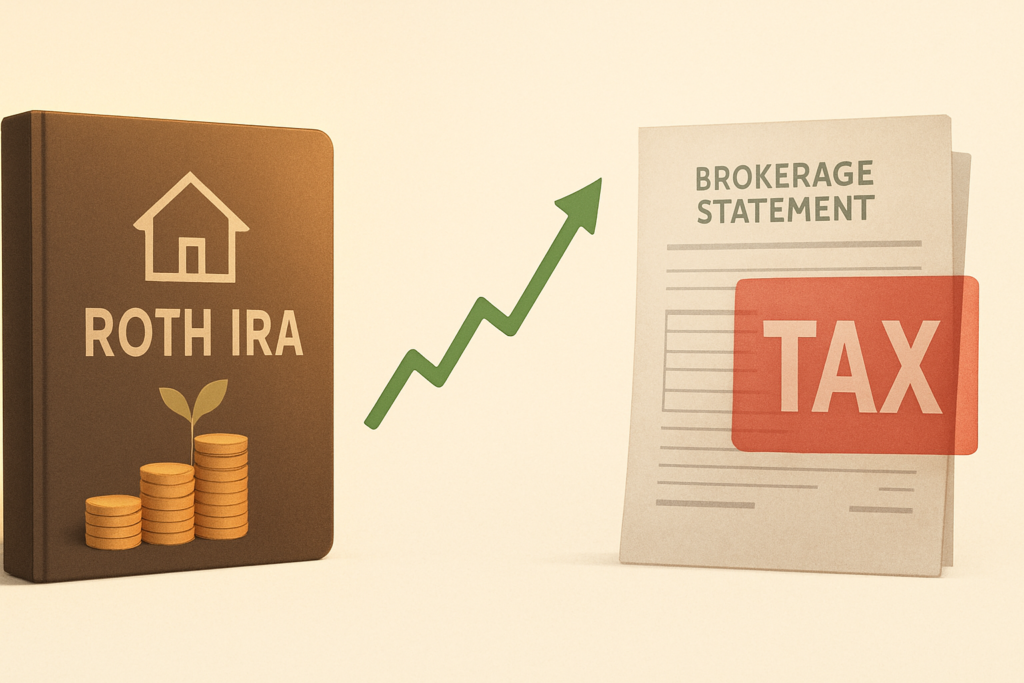
Most investors think about what they own. The better investors also think about where they own it. That second question — account location, not just asset allocation — is one of the most underrated moves in a tax-efficient portfolio. And REITs are the single clearest example of why it matters.
If you’re holding a REIT fund in a taxable brokerage account right now, there’s a decent chance you’re quietly handing the IRS 22 to 37 percent of your annual dividend income before you ever see it. Same asset, same returns, wrong wrapper.
Here’s the direct answer: hold your REITs in your Roth IRA. Full stop. And here’s the math that makes the case.
Why REITs Create a Tax Problem in Taxable Accounts
Real estate investment trusts are required by law to distribute at least 90 percent of their taxable income to shareholders. That’s the whole deal — REITs are pass-through structures, and that generous dividend yield is why people buy them. Historically, REITs have yielded 3 to 5 percent annually in dividends, well above the S&P 500’s typical 1.2 to 1.5 percent.
Here’s the catch. Most REIT dividends are classified as "ordinary dividends," not "qualified dividends." That distinction is critical. Qualified dividends from stocks like Apple or Microsoft get preferential tax rates — 0, 15, or 20 percent depending on your income. Ordinary dividends from REITs get taxed at your regular income tax rate. If you’re in the 22 percent bracket, that’s 22 percent. If you’re in the 24 percent bracket, that’s 24 percent. And if you’ve built up a solid portfolio by 48, there’s a real chance you’re already brushing up against the 32 percent territory.
Let’s put numbers to it. Say you hold $30,000 of a REIT index fund in a taxable account, earning a 4 percent dividend yield. That’s $1,200 per year in dividends. If they’re taxed as ordinary income at 22 percent, you owe $264 in taxes on income you likely reinvested automatically — money you never spent but still had to report. Over 15 years to retirement at 63, that tax drag compounds. It’s not trivial.
In a Roth IRA, that same $1,200 in annual dividends is never taxed. Not now, not when you reinvest them, not when you withdraw them at 65. Zero. That’s the structural advantage, and it’s permanent.
The Tax Efficiency Hierarchy for REITs
Think of your accounts in order of tax efficiency, from best to worst for holding REITs:
Roth IRA (best): Contributions grow tax-free, dividends reinvest tax-free, and qualified withdrawals in retirement are completely untaxed. For high-dividend assets like REITs, this is the gold standard. Every dollar of REIT dividend that compounds inside a Roth is yours forever.
Traditional IRA or 401k (second best): Dividends and growth are tax-deferred, not tax-free. You’ll owe ordinary income tax when you withdraw. But deferral is still powerful — you’re not paying taxes on dividends year by year during accumulation, so compounding is uninterrupted. The bill comes later. For REITs, this is still dramatically better than a taxable account.
Taxable brokerage (worst for REITs): Dividends taxed as ordinary income annually, even if reinvested. Capital gains taxed upon sale. No deferral. The tax drag is real and relentless.
The lesson isn’t that you should never own REITs in a taxable account. If you’ve maxed your Roth and your 401k and you still want REIT exposure, a taxable account is better than no exposure. But given a choice, the Roth wins by a wide margin.
What This Looks Like at 48 With $95,000 Saved
At 48, you’re likely splitting money across two or three account types: a 401k through work, possibly a Roth IRA you’ve been funding since your 30s, and maybe a taxable brokerage account you opened for flexibility. That’s a healthy structure — and it gives you real choices about where to place each asset class.
I spent 30 years at the National Weather Service tracking systems where small inputs compound into outsized outcomes. A tropical wave that barely registers in July can be a major hurricane by late August. Tax drag on a REIT portfolio works the same way — small annual leakage that looks manageable in any given year compounds into a meaningful gap over a decade or two. The difference between Roth-held REITs and taxable-held REITs at retirement is not $264 per year. It’s the accumulated cost of reinvesting after-tax dollars instead of pre-tax ones, year over year, with compounding.
For a 48-year-old with $95,000 saved and 15 to 17 years of runway before retirement, placing REITs in the Roth IRA is a clear decision. Here’s a practical framework:
- Hold your total stock market or S&P 500 index fund in the taxable account. These generate low dividends (often qualified) and produce minimal annual tax events unless you sell.
- Hold your international stock index fund in the taxable account — there’s often a foreign tax credit available, which slightly offsets the tax drag.
- Hold your bond funds and your REIT exposure inside tax-advantaged accounts (Roth or 401k).
This isn’t a rule carved in stone. It’s a general principle that improves your after-tax outcome without requiring you to change what you own — only where you own it.
How Much Should REITs Be in Your Portfolio at 48?
Reasonable range: somewhere between 5 and 15 percent of total invested assets, depending on whether you already own real estate. If you own a home and are already carrying real estate exposure on your net worth balance sheet, erring toward the lower end of that range makes sense — you don’t need to double down on real estate in your portfolio. If you’re renting and want some exposure to real estate returns without becoming a landlord, REITs fill that gap efficiently.
On a $95,000 portfolio, 10 percent REIT allocation means $9,500 in a REIT index fund. If your Roth IRA has that capacity, that’s where it goes. A broad REIT index fund — Vanguard REIT Index (VNQ), Schwab REIT (SCHH), or a total real estate index fund — gives you exposure across hundreds of properties and property types without picking individual REITs.
A book like The Bogleheads’ Guide to Investing covers asset location in detail and is one of the most practically useful investing books I’ve come across for this exact type of question — low cost, tax efficiency, account location all in one place. It’s the book I wish I’d had in my 30s when I was figuring out how my NWS Thrift Savings Plan account fit with a Roth I’d opened on the side.
What If Your Roth IRA Is Already Full?
Good problem to have. If you’ve maxed your Roth IRA for the year (contribution limits update annually — verify at IRS.gov, but the current limit is $7,500 per year for under-50s), your next-best location for REITs is your 401k, if you have investment options there that include a REIT fund. Many 401k menus include a real estate fund — it may not be a pure REIT index, but it’s better than taxable placement.
If your 401k menu doesn’t include a real estate option, consider tilting your 401k toward the bond funds and using your Roth IRA exclusively for your REITs and other tax-inefficient assets. The goal is to use each account’s tax structure to its full advantage.
If you’ve maxed both and still have REIT money to invest: taxable account is fine. A 4 percent dividend yield taxed at 22 percent isn’t catastrophic. The gap between Roth and taxable is meaningful, but it’s not a reason to skip REITs altogether if you believe in the exposure.
The Bigger Picture: Asset Location as a Strategy
This REIT question is a specific instance of a broader principle: asset location — deliberately placing each asset class in the account type where it faces the least tax friction — can add 0.2 to 0.5 percent per year to your after-tax returns without taking on more risk or changing your overall allocation. On a $95,000 portfolio growing over 17 years, that’s real money.
For a deeper look at how this fits into your overall retirement math — specifically what you should have in your 401k by now and whether you’re on track — see our breakdown of how much you should have in your 401k at 45 to retire at 65 with $5,000 a month. The numbers there pair directly with the asset location strategy here.
And if you’re curious about whether lump-sum investing or gradual deployment matters as much as account location for long-term outcomes, our analysis of lump-sum vs. dollar-cost averaging with a $24,000 bonus covers the data clearly. Short answer: asset location is a higher-leverage decision than timing. Where you hold things beats when you put them in.
Finally, once you’re clear on account location and allocation, the downstream question is how much you can safely pull from those accounts in retirement. Whether the 4 percent rule is safe for a $580,000 retirement portfolio depends significantly on how much of that portfolio lives in a Roth (where withdrawals don’t affect your income-based calculations) versus a traditional IRA or 401k. Asset location now shapes your withdrawal flexibility later.
The Action Step
If you don’t have a Roth IRA yet — or you haven’t funded one recently — open one now. Fidelity, Vanguard, and Schwab all have no-minimum Roth IRA accounts. Open an account at Fidelity.com or Schwab.com, set up a contribution for this tax year, and direct that money into a broad REIT index fund as part of your overall allocation. It takes about 15 minutes and you’ll never owe taxes on that growth again.
If you already have a Roth IRA and you’re currently holding a REIT fund in a taxable account instead: you can rebalance. Sell the REIT position in your taxable account, hold cash briefly, and fund your Roth IRA contribution. Then buy the REIT fund inside the Roth. One repositioning, permanent tax benefit. Tax-Free Retirement by Patrick Kelly is a good companion read if you want to understand the full arc of tax-free investing across different account types — it’s more accessible than it sounds. And for a straightforward book on why expense ratios and tax placement matter far more than picking the right stock, The Simple Path to Wealth by JL Collins has convinced more late-30s and 40s investors to simplify and optimize than almost any other personal finance book I’ve seen.
Bottom line: own what you want. But put it where the IRS takes the smallest bite. For REITs, that’s the Roth IRA. Not close.