
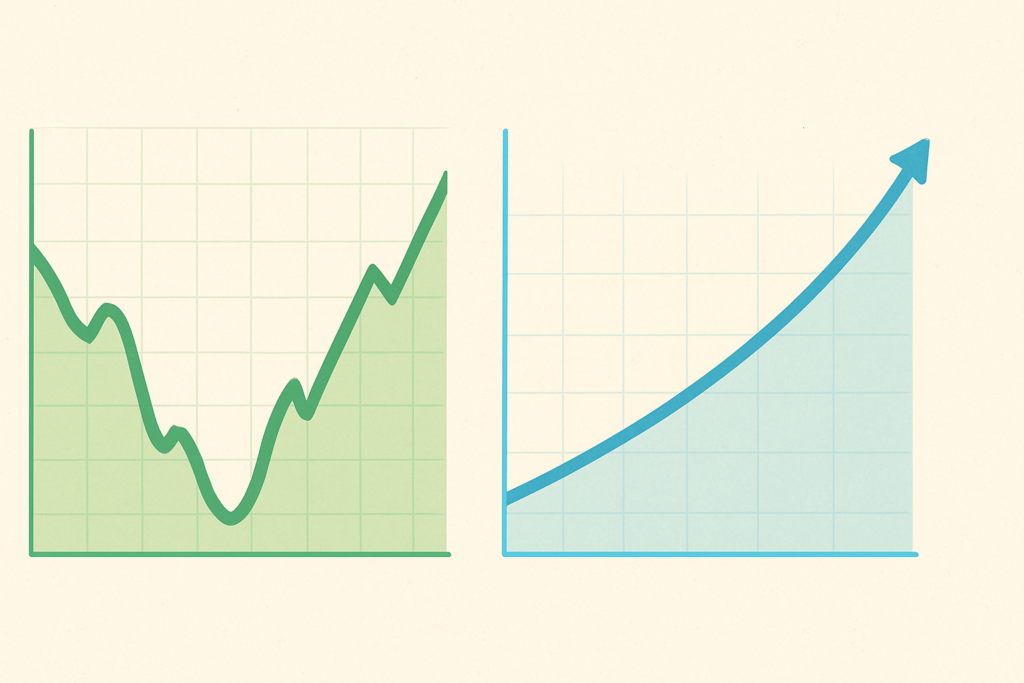
Most investors watch their IRA drop 20% during a market correction and feel pure dread. That’s understandable. But if you have a traditional IRA and you’re thinking about converting some of it to a Roth, a falling market is one of the few financial situations where the bad news actually creates a real opportunity. The logic runs counter to instinct, which is exactly why most people miss it.
Here’s the core idea: when you convert traditional IRA money to a Roth, you pay ordinary income tax on the amount converted. The tax bill is based on the market value of those assets at conversion time — not what they were worth before the drop, and not what they’ll be worth when markets recover. Convert during a downturn, and you’re paying taxes on depressed values. When the market recovers — and it does recover — all of that appreciation happens inside the Roth, where it’s permanently tax-free.
That’s not a minor tactical tweak. On a $300,000 IRA, it can mean the difference between a manageable tax bill and an unnecessarily large one.
The Math That Makes This Work
Let’s run a concrete example. Assume you have $300,000 in a traditional IRA and you’re in the 22% federal tax bracket. Markets drop 25%. Your IRA is now worth $225,000.
You decide to convert $50,000 worth of IRA holdings to your Roth.
During the downturn, the tax on that $50,000 conversion: $50,000 × 22% = $11,000.
Now markets recover. The assets you converted bounce back 33% (returning to their pre-drop value). That $50,000 conversion is now worth $66,500 inside your Roth — and every dollar of that $16,500 gain is permanently tax-free.
Compare that to waiting for the recovery and then converting $66,500 of fully-valued assets: the tax would be $66,500 × 22% = $14,630. You’d pay $3,630 more in taxes for the same result. And that gap compounds even further over time as the Roth account continues to grow.
The bigger the drop, the larger the opportunity. A deeper correction means more assets available to convert at depressed prices, more future appreciation that will occur tax-free, and a larger effective discount on the tax bill relative to converting at normal prices.
Who This Strategy Actually Makes Sense For
This isn’t right for everyone. The opportunity comes with conditions.
You need cash outside the IRA to pay the taxes. This is the non-negotiable requirement. If you fund the tax bill by withholding from the conversion itself — taking money out of the IRA to pay the IRS — you’ve defeated the math entirely. Withholding from a conversion is effectively taking a taxable early distribution, and on top of the conversion tax, you lose the assets that would otherwise be growing tax-free inside the Roth. Pay the taxes from a savings account, a taxable brokerage account, or other non-IRA funds. Period.
You’re in a tax bracket that’s favorable now compared to later. Roth conversions make the most sense when your current tax rate is lower than your expected future rate. For many people approaching retirement with significant IRA balances, this window opens in the gap years between early retirement (when income drops) and age 73 when required minimum distributions kick in. A market-drop year inside that window is particularly valuable.
The conversion doesn’t push you into a higher bracket or trigger Medicare IRMAA surcharges. This is where careful planning matters. The IRMAA surcharge — Medicare’s income-related premium adjustment — kicks in two years after the year of the conversion, which means a large Roth conversion today can unexpectedly raise your Medicare premiums 24 months from now. Know your modified adjusted gross income ceiling before converting, and stay under it if IRMAA is a concern.
You have time for the Roth to compound. The tax-free compounding benefit is most powerful over long periods. A 55-year-old converting during a downturn has 30+ years of potential tax-free growth ahead. A 72-year-old converting has fewer years of compounding but could still benefit from reducing future RMDs or leaving tax-free assets to heirs.
The Downturn Creates Two Separate Advantages
There’s a subtler dynamic here worth understanding. When markets drop, you get two independent advantages from converting:
Advantage 1: Fewer dollars of converted value, same number of shares. If a fund unit dropped from $100 to $75, you can convert the same number of shares while reporting less taxable income. You’re buying the same future upside at a 25% tax discount.
Advantage 2: The IRS taxes you on suppressed values. Even if you’re converting a fixed dollar amount ($50,000 regardless of market conditions), the assets inside that $50,000 represent more shares at depressed prices. When those shares recover, you own more of the rebound inside the tax-free Roth wrapper.
I spent three decades as a meteorologist for the National Weather Service, and one thing that career taught me is to recognize when conditions align to create an unusual opportunity — not to assume they’ll persist, but to act when they’re present. A 20-25% market correction inside a favorable tax bracket is that kind of alignment. It doesn’t happen every year. When it does, it’s worth taking seriously.
What You Actually Do: The Process
The mechanics are straightforward once you’ve decided to proceed.
- Estimate your taxable income for the year without any conversion. Know where you sit in your current bracket and how much room you have before the next bracket begins. For the 22% bracket (income roughly $47,000–$100,000 for single filers, $94,000–$201,000 for married filing jointly — verify current limits as thresholds adjust), figure the maximum you can convert while staying in the 22% tier.
- Calculate the IRMAA exposure if you’re 63 or older. The surcharge applies two years forward. Run the numbers with your tax professional or use SSA’s online IRMAA estimator before committing to a conversion amount.
- Initiate the conversion at your brokerage. Fidelity, Vanguard, and Schwab all support Roth conversions online. You specify the amount or the shares to convert, and the process typically settles within a few business days. The brokerage will issue a 1099-R and 5498 at year end.
- Pay the estimated taxes. Converted amounts are taxable in the year of conversion. If you’re not having taxes withheld from a paycheck, make a quarterly estimated tax payment to cover the conversion to avoid underpayment penalties. The IRS safe harbor: pay at least 100% of last year’s tax liability (110% if your AGI exceeded $150,000), and you’re protected from penalties regardless of the final amount owed.
The Tax-Efficient Placement Question
Once you’ve converted, asset allocation inside the Roth matters. The highest-growth assets belong in the Roth — small-cap equities, emerging market funds, anything with strong long-term appreciation potential. The Roth’s tax-free compounding works hardest on assets with the most upside. Bonds and stable-value holdings are better suited for taxable or traditional accounts where their lower growth rate makes the tax drag less painful.
After converting during a downturn, consider repositioning within the Roth toward higher-growth holdings to maximize the tax-free compounding benefit once markets recover. This is the full play, not just the conversion.
When It Doesn’t Make Sense
A market downturn doesn’t automatically justify converting. Skip it if:
- You’d need to withhold from the conversion itself to pay the taxes — that’s structurally bad
- The conversion amount would push you into the 32% bracket or higher, where you’re paying a premium tax rate today to avoid a potentially lower rate later
- You’re within two years of Medicare eligibility and a large conversion would trigger multi-year IRMAA surcharges that exceed the conversion benefit
- You don’t have a long enough horizon for the tax-free growth to exceed the immediate tax cost
The Roth vs. Traditional question depends fundamentally on your expected tax rate in retirement, and a downturn conversion doesn’t change that underlying logic — it just makes the execution cheaper when conditions are right.
Run the Numbers Before the Market Recovers
Market downturns don’t last indefinitely. The window for converting at depressed valuations is exactly as long as the correction — which means if you’re considering this, the time to model it is now, not after recovery has begun.
Start by pulling up the Roth conversion calculator at Schwab’s Roth IRA conversion page (or Fidelity or Vanguard — all three offer free planning tools), which lets you model different conversion amounts, tax rates, and time horizons. Input your current IRA value, your estimated income for the year, and the conversion amount you’re considering, and you’ll see the breakeven point and projected after-tax advantage over 10, 20, and 30 years.
Then run it by a fee-only tax advisor or CPA before executing — especially if you’re within IRMAA range or you have a traditional IRA with after-tax contributions (where the pro-rata rule complicates the picture). For deeper reading on the strategy, retirement tax planning books focused on Roth conversions walk through the bracket management, IRMAA interaction, and estate planning angles in detail. And James Lange’s Retire Secure is one of the more thorough treatments of the multi-year conversion strategy for larger IRA balances.
The opportunity is real. It just requires moving while conditions favor it.