
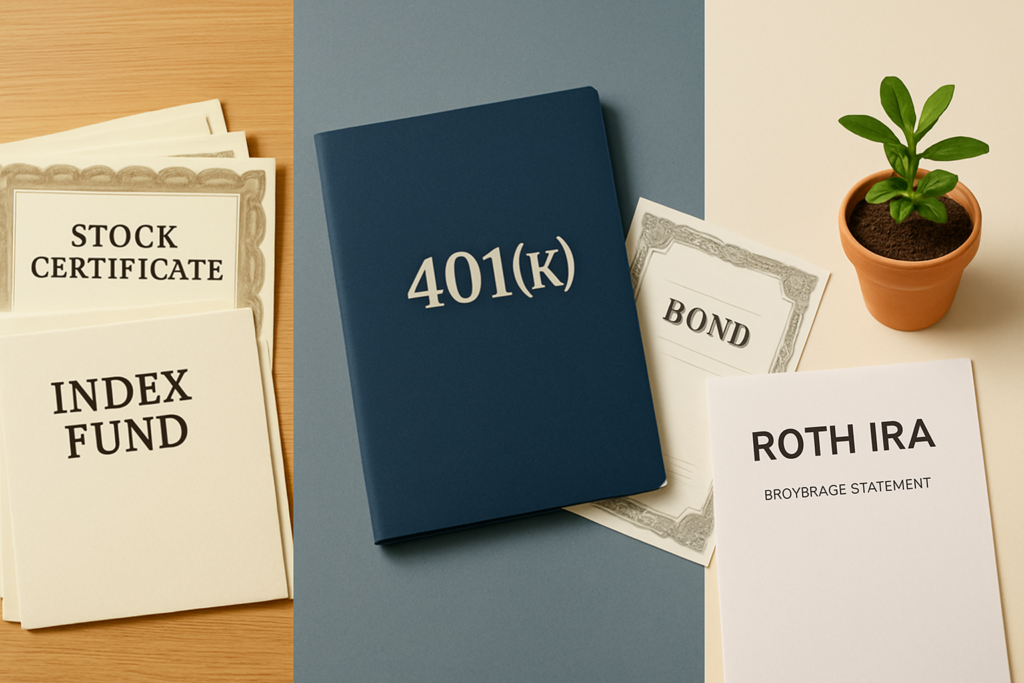
Most investors spend serious time thinking about what to own — index funds vs. actively managed, how much in bonds, whether to add international exposure. That’s legitimate. But there’s a quieter question that often saves more money than any of those decisions: which account holds what.
Location matters. A lot. Put the wrong assets in the wrong accounts and you’ll pay taxes you didn’t have to pay, year after year, for decades. I’ve watched people meticulously select low-cost funds and then park them in the most tax-costly arrangement possible. The fund choice was fine. The placement cost them.
I spent 30 years as a Warning Coordination Meteorologist for the National Weather Service. One thing that job teaches you: precision in the right places prevents a lot of preventable damage. Imprecision in the details — even when the big picture is correct — is where things go wrong. Tax-efficient asset location is one of those details that actually pays.
Three Account Types, Three Different Tax Rules
To understand why placement matters, you need to understand what’s different about each account type.
Taxable brokerage account: No special tax treatment. You pay taxes on dividends and interest each year, as they’re distributed, regardless of whether you sell anything. When you eventually sell, you pay capital gains tax — at the lower long-term rate if you held more than a year, at your ordinary income rate if you didn’t.
Traditional 401k or Traditional IRA: Contributions are pre-tax. Everything grows tax-deferred. You pay ordinary income tax when you withdraw — in retirement, at whatever tax rate applies then. Bonds, for example, generate interest income that would be taxed as ordinary income in a taxable account. Inside a 401k, that interest compounds without annual taxation.
Roth IRA or Roth 401k: Contributions are after-tax. Growth is completely tax-free. Qualified withdrawals in retirement are tax-free. This is your most powerful shelter — the assets that grow the most here generate the most benefit, because none of that growth will ever be taxed.
The goal of asset location is simple: match the tax character of an investment with the account where it creates the least annual tax drag.
Rule 1: Taxable Brokerage — Tax-Efficient Assets Only
What belongs in your taxable account? Assets that don’t generate much taxable income along the way.
The best candidates:
- Broad stock market index funds (VTI, FZROX, SWTSX): These track the total U.S. market. They have very low turnover — most index funds don’t constantly sell and rebuy holdings — which means minimal capital gains distributions each year. They generate some dividends, but qualified dividends are taxed at the lower long-term capital gains rate (0%, 15%, or 20% depending on your income), not ordinary income rates.
- S&P 500 index funds (VOO, FXAIX, SWPPX): Same story. Low turnover, tax-efficient dividends.
- Tax-managed funds: Some funds are designed specifically to minimize taxable distributions. Vanguard Tax-Managed Capital Appreciation is one; a few others exist. Worth knowing about if you’re in a high tax bracket.
What doesn’t belong in taxable? Anything that generates income taxed at ordinary rates: actively managed funds with high turnover, bond funds that pay interest monthly, REITs that distribute large chunks of ordinary income. More on those in a moment.
One important note: the capital gains tax rate you’ll pay when you eventually sell in your taxable account depends on your income and how long you’ve held the investment. Holding index funds for years in a taxable account, then selling at the long-term rate, is far less painful than holding a bond fund that generates ordinary income every single year.
Rule 2: Traditional 401k and IRA — Shelter Your Tax-Inefficient Assets
The best assets for your tax-deferred accounts are the ones that generate the most ordinary income. Because inside a 401k or Traditional IRA, that income accumulates without annual taxation. You’ll pay ordinary income tax eventually — but not until you pull the money out, ideally in retirement when your income (and tax rate) may be lower.
Put here:
- Bond funds: Bond interest is taxed as ordinary income — potentially at 22%, 24%, or higher. Inside your 401k, that interest compounds without annual taxation. Big difference over 20 years.
- TIPS (Treasury Inflation-Protected Securities): These generate both interest income AND phantom income from inflation adjustments — you owe taxes on the inflation adjustment even though you haven’t received cash. Not good in taxable. Fine inside a 401k.
- Actively managed funds: Higher turnover funds frequently realize capital gains internally and pass them to shareholders. If you’re going to hold one, do it inside a 401k or IRA where those gains don’t create an annual tax bill.
- Target date funds: If your 401k holds a target date fund as its primary vehicle, that’s completely fine — the simplicity benefit outweighs the slight inefficiency. Don’t disrupt a solid target date fund setup just to optimize asset location. The bond allocation inside a target date fund is already tax-sheltered by being in your 401k, which is the right behavior.
Rule 3: Roth IRA — Your Highest-Growth Assets Go Here
This is where the math gets genuinely exciting, if you’re the type of person who finds 20-year tax projections exciting. Which I am, so bear with me.
Roth accounts are unique: the growth is completely tax-free. Forever. You never pay taxes on Roth gains, not when you rebalance, not when you sell, not when you withdraw in retirement. That makes the Roth your most powerful account — and it means you want to put your highest expected return assets here, not just random holdings.
The best Roth candidates:
- REITs (Real Estate Investment Trusts): REITs are legally required to distribute at least 90% of their taxable income to shareholders. Most of those distributions are taxed as ordinary income — not the lower qualified dividend rate. In a taxable account, REITs create a significant annual tax bill. Inside a Roth, all of that distribution income compounds tax-free. The specific math on holding REITs in a Roth vs. taxable account shows just how large this difference can be over 15–20 years — we’re talking tens of thousands of dollars on a meaningful REIT position.
- Small-cap and international funds with higher expected growth: If you believe small-cap value or international stocks will outperform over your remaining investment horizon, you want those in the Roth. The higher the eventual return, the more valuable the tax-free shelter becomes.
- High-dividend equity funds: The question of whether dividend stocks belong in a Roth or taxable account has a nuanced answer — qualified dividends in a taxable account are taxed at the lower long-term rate, which is tolerable. But if you’re holding high-yielding dividend funds where income is substantial, the Roth shelter adds real value over time.
What This Actually Looks Like With Real Numbers
Take a household with $500,000 invested: $200,000 in a taxable brokerage account, $200,000 in a Traditional 401k, and $100,000 in a Roth IRA. They hold a three-fund portfolio: 60% total stock market, 30% bonds, 10% international.
Wrong arrangement: Bonds split randomly across all three accounts. Total stock market in the 401k. REITs in the taxable account. The bonds generate ordinary income in the taxable account every year, taxed at 22%. The REITs generate non-qualified distributions in the taxable account, also taxed at ordinary rates. The stock market index fund sits in the 401k, where its already-low dividend yield gets tax treatment that’s wasted — it would’ve been fine in taxable.
Right arrangement: Bonds entirely in the 401k. REITs in the Roth. Total stock market and international index funds in the taxable account. Nothing changes about the total return of the portfolio. What changes is how much of that return you keep.
The difference over 20 years, assuming a 22% ordinary income rate and 15% long-term capital gains rate, can easily reach $50,000–$80,000 on a portfolio this size. Not from better stock picking. Just from getting the accounts right.
The Practical Steps to Implement This
You don’t have to do this all at once, and you don’t have to sell taxable holdings to rebalance (which would create a taxable event). Here’s the practical approach:
First, stop. Don’t make any moves in your taxable account that trigger capital gains just to shuffle things around. The optimization isn’t worth paying taxes to achieve.
Second, use new contributions to gradually shift. If you’re making monthly 401k contributions, direct those toward bonds. If you’re contributing to your Roth each year, put that money into your highest-growth holdings. Over a few years, the allocations naturally migrate toward the right arrangement.
Third, if you have both a Roth and taxable account holding similar assets — say, S&P 500 in both — you can exchange them. Sell the bonds in your taxable account and buy bonds in the 401k instead. Buy S&P 500 in the taxable account with the freed-up space. This is a same-day rebalance that doesn’t change your overall portfolio but improves its tax efficiency.
Fourth, check your Roth IRA. If it’s holding bond funds or a balanced fund because that’s what you set up years ago and never revisited, now’s the time to shift toward higher-expected-return assets. Inside the Roth, you can trade freely with no tax consequences.
The Exceptions Worth Knowing
If you only have a 401k and no taxable account, asset location is irrelevant — everything’s in one place, and you optimize what you can within that plan’s fund menu. Don’t get distracted by a strategy that requires multiple account types when you’re still building toward that.
If you’re five to ten years from retirement and your primary goal is simplicity, a target date fund in the 401k plus a broad index fund in your taxable account is completely reasonable. Imperfect location beats no investment entirely.
And if the 401k fund options are limited — many employer plans offer only a few decent choices — don’t stress about placing specific assets there. Use the best available funds in the 401k and optimize the accounts you fully control (Roth IRA, taxable brokerage) instead.
Where to Start Today
If you don’t yet have a Roth IRA, open one. The annual contribution limit is $7,000 for most people ($8,000 if you’re 50 or older), and a Roth IRA at Fidelity or Vanguard costs nothing to open and nothing to maintain. With that account in place, you have the full three-account toolkit to implement proper asset location. Go to fidelity.com or vanguard.com, open a Roth IRA (takes about ten minutes), and fund it with an initial contribution. Then you can begin placing your highest-growth holdings there.
If you already have all three account types and just haven’t thought about which assets go where, start by checking what’s in your Roth. If it’s holding a bond fund or a balanced fund, that’s the first thing to fix — move that to the 401k and put your growth-oriented holdings in the Roth instead. No tax consequence for trading inside the Roth.
For getting the conceptual foundation solid before you restructure, The Bogleheads’ Guide to Investing covers asset location clearly and is the book I’d hand anyone who wants to do this right. The Millionaire Next Door is a good companion for the broader wealth-building mindset — the tax efficiency decisions are the implementation layer on top of a lifetime of consistent saving. And for the mechanics of tax-efficient withdrawal strategies in retirement, Can I Retire Yet? by Darrow Kirkpatrick is underrated — it covers account sequencing in retirement in a way most books skip.
The investments you choose matter. So does where you put them.