
Most homeowners who decide to borrow against their home equity spend exactly zero time comparing their two main options. They hear "HELOC" or "home equity loan" from a friend or lender, go with whichever one sounds familiar, and sign the paperwork. Then rate fluctuations happen, or the renovation scope expands, and suddenly the loan structure they chose is costing them a lot more than the alternative would have.
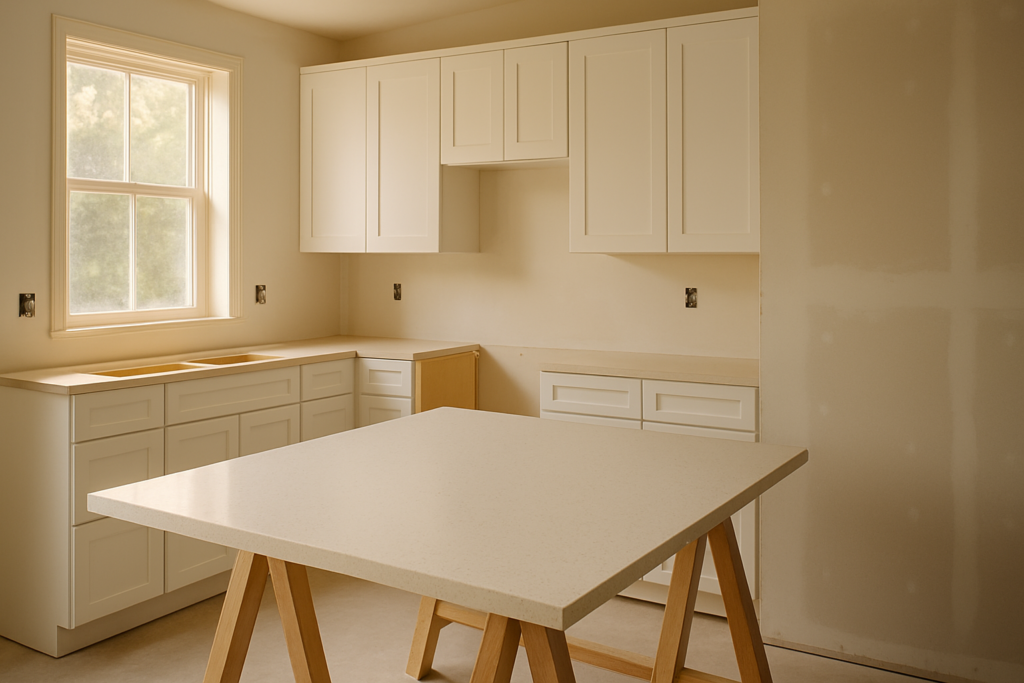
For a $45,000 kitchen remodel — which is a completely realistic mid-range number for a full gut renovation including new cabinets, countertops, appliances, and flooring — the choice between a HELOC and a home equity loan can mean a difference of $3,000–$8,000 in total interest paid depending on how rates move over the repayment period. That’s real money. Worth 30 minutes of research before you sign anything.
Here’s the comparison done properly.
The Basic Mechanics: How Each One Works
Home Equity Loan: You borrow a lump sum — in this case, $45,000 — at a fixed interest rate, and repay it in fixed monthly payments over a set term (typically 10, 15, or 20 years). The rate is locked on the day you close. It never changes. Your payment is the same every month from the first payment to the last.
HELOC (Home Equity Line of Credit): You get approved for a credit line up to a maximum amount — say, $60,000 — but only borrow what you need, when you need it. The draw period (typically 5–10 years) lets you pull money as needed, paying only interest on what you’ve drawn. After the draw period ends, the repayment period begins — usually 10–20 years of principal + interest payments. The interest rate on a HELOC is variable, tied to the prime rate, and moves up or down as rates change.
Both products use your home as collateral. Both typically require at least 15–20% equity in your home after borrowing. Both require an appraisal in most cases. The fundamental difference is rate structure and flexibility.
The Rate Reality: Fixed vs. Variable Right Now
Here’s where the $45,000 kitchen remodel decision gets concrete. Home equity loan rates and HELOC rates are typically within 0.5–1.5% of each other at any given time, but they behave very differently over time.
At rates as of this writing (verify current rates at your lender or Bankrate.com before applying — rates change frequently):
- Home equity loan: Fixed rates generally running in the 8.0–9.5% range for borrowers with good credit (700+). Your rate is set for the life of the loan.
- HELOC: Variable rates also in the 8.0–9.5% range currently, but tied to prime rate. When the Federal Reserve cuts rates, your HELOC rate drops. When rates rise, your HELOC rate rises within 30–60 days of the Fed move.
For a $45,000 home equity loan at 8.5% over 15 years: monthly payment = approximately $443, total interest paid = approximately $34,700.
For a $45,000 HELOC drawn all at once at 8.5% variable with a 10-year draw (interest only) + 10-year repayment: interest-only payments during draw = approximately $319/month. After draw period, repayment payments at whatever rate exists then. Total interest depends almost entirely on where rates land over those 20 years — could be less than the home equity loan if rates fall significantly, or substantially more if rates climb.
Why the Fixed Loan Wins for a Specific, Bounded Project
For a kitchen remodel with a known scope and a contractor quote in hand, I’d take the home equity loan. Not because variable rates are inherently bad, but because the entire financial advantage of a HELOC — its flexibility — doesn’t apply when you know exactly what you’re spending and when.
The HELOC’s variable rate is a bet that rates will stay flat or fall over your repayment period. That bet might pay off. It might not. A fixed home equity loan eliminates the bet entirely. You know on day one that your $45,000 costs you exactly $443/month for 15 years and exactly $34,700 in interest. No surprises. No refinancing required. No watching the Fed calendar anxiously.
Kitchen renovations also tend to have scope creep — the contractor finds something behind the walls, the appliances you wanted are backordered and you upgrade, the countertop material costs more than estimated. That scope creep can be handled with a small cash buffer or a minor credit card charge, not by drawing more from a credit line. For smaller renovations under $20,000, other financing options sometimes beat both — but at $45,000, you’re firmly in home equity territory.
When the HELOC Actually Wins
There are real scenarios where a HELOC is the smarter choice. Be honest with yourself about which situation you’re actually in:
- Multi-phase renovation: You’re doing the kitchen this year, the master bath next year, and possibly a deck addition the year after. Drawing from a HELOC over three years is much cheaper than taking out three separate home equity loans with three sets of closing costs.
- Unknown project scope: If the contractor says "we won’t know exactly what’s behind the walls until demo day," a HELOC lets you borrow what you actually need rather than a lump sum based on an estimate that may miss by $10,000–$20,000.
- Short repayment horizon: If you’re confident you can pay off the balance within 3–5 years (perhaps from a bonus, inheritance, or home sale proceeds), a HELOC at current rates — especially if rates fall during that window — may cost less total than a 15-year fixed loan.
- Rate environment inflection point: If you believe interest rates will fall significantly in the next 12–18 months, the HELOC benefits from that drop automatically. The fixed home equity loan doesn’t. This is a market timing bet — make it carefully and honestly.
The Closing Cost Question — It’s Not Free Money Either Way
Both products have closing costs that often get glossed over in lender marketing. This matters for the total cost calculation.
Home equity loan closing costs: Typically 2–5% of the loan amount. On $45,000, that’s $900–$2,250 in upfront costs for appraisal, origination, title search, and recording fees. Some lenders offer "no closing cost" home equity loans but typically charge a slightly higher rate in exchange — run the math on your specific lender’s offer.
HELOC closing costs: Generally lower — often $0–$500 for smaller lines, with some lenders waiving costs entirely on HELOCs to attract the relationship. However, many HELOCs also have annual fees ($50–$100/year) and some have inactivity fees if you don’t draw from the line within a certain period.
On a $45,000 borrow, if the home equity loan has $1,500 in closing costs and the HELOC has $200, that $1,300 difference matters. It takes about 2.5–3 years of the fixed loan’s savings in interest predictability to make up that gap. Break-even math applies to any loan refinance or product switch — always calculate how long until you come out ahead, not just whether the rate is lower.
The Equity and DTI Requirements You Need to Meet
Before you apply for either product, know what lenders actually require. Most lenders want:
- At least 15–20% equity remaining after the loan. If your home is worth $350,000 and you owe $280,000, you have $70,000 in equity. Borrowing $45,000 leaves $25,000 in equity — about 7% — which is below most lenders’ minimums. You’d need more equity or a smaller loan. Most lenders cap combined loan-to-value (CLTV) at 80–85%.
- Credit score of 680+ for standard rates; 720+ for the best rates. Below 680, you’ll get offered rates significantly higher than the market average.
- Debt-to-income ratio below 43%. Your DTI calculation includes all monthly debt payments divided by gross monthly income — adding a $443/month home equity loan payment changes your DTI meaningfully if you’re already carrying other loans.
Run your numbers before applying anywhere. A hard credit pull for a loan you won’t qualify for costs you points and reveals nothing useful.
The Decision Framework in Plain English
Take the home equity loan if:
- You have a firm contractor quote and a defined scope
- You prefer predictable, fixed monthly payments
- You don’t anticipate additional renovation phases in the next few years
- You’re worried about rates rising further
Take the HELOC if:
- You’re doing multiple renovation phases over several years
- You want to borrow only what you actually spend (not a lump sum estimate)
- You expect to pay it off within 5 years
- You think rates will fall and you want to benefit from that automatically
Neither option is inherently wrong. The wrong move is choosing without running the numbers specific to your project and your financial situation.
Books Worth Reading Before You Sign Anything
If this is your first home equity product and you want to understand how it fits into your overall financial picture, a homeowner’s guide to home equity borrowing covers the mechanics and risks in more detail than any lender will explain at closing. For the renovation side of the equation, a kitchen remodel planning guide is useful for keeping scope and budget realistic before you borrow a dollar — cost overruns are how $35,000 kitchen plans become $55,000 projects. And if you want to understand how home equity fits into a broader wealth-building strategy, a homeowner wealth building book addresses how and when tapping equity makes sense vs. when it undermines long-term financial security.
Get Competing Quotes Before You Commit
The single most important action you can take right now: get at least three quotes for both a home equity loan and a HELOC on your specific home, your specific loan amount, and your specific credit profile. Rates and closing costs vary significantly between lenders. Your current bank or credit union is a starting point — not a final answer. Check LendingTree.com or Bankrate’s home equity comparison tool to see rates from multiple lenders simultaneously without a hard credit pull. Then take your best offer back to your primary bank and ask them to match it. They often will. The 10–15 minutes that comparison takes routinely saves $1,000–$3,000 in total interest on a $45,000 project.