
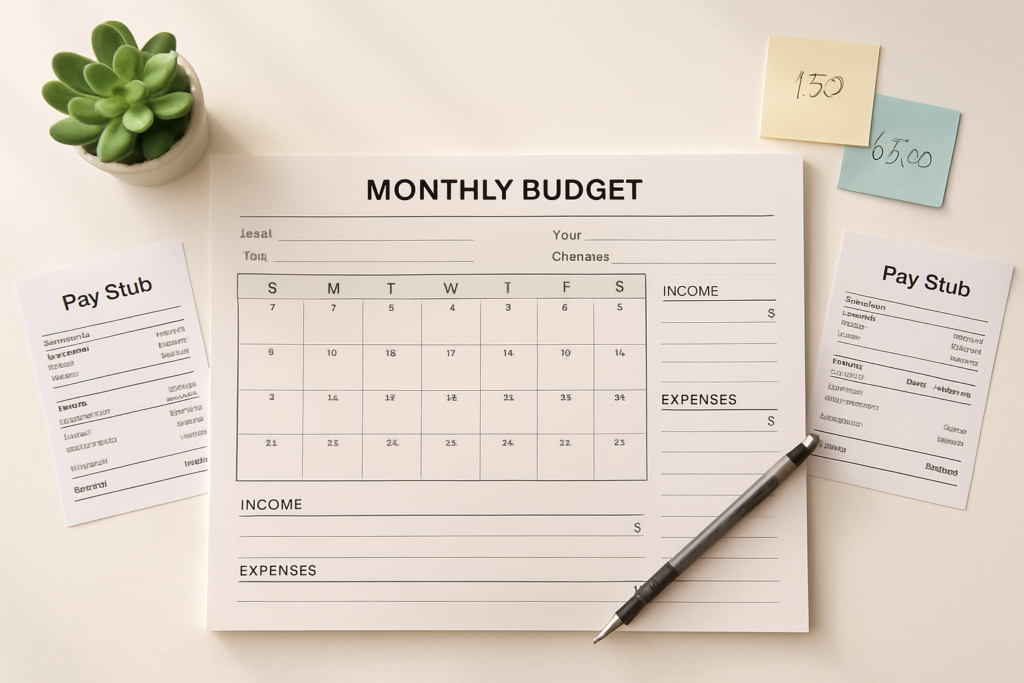
If you’ve ever felt like your paycheck doesn’t quite line up with your bills, you’re probably not imagining it — and you’re probably not bad at math. You’re dealing with a calendar problem that nobody explains when you start a job: biweekly pay and monthly expenses don’t fit together cleanly, and the mismatch trips up even people who consider themselves responsible with money.
Here’s the number most biweekly workers don’t know: you don’t get paid twice a month. You get paid 26 times a year. That’s two extra paychecks compared to what a monthly budget built on 24 semi-monthly checks expects. And if you don’t have a plan for those two "extra" paychecks — the ones that show up in the months where three Fridays (or three Mondays, or three Wednesdays) fall in the same pay cycle — they tend to disappear into the background noise of regular spending without doing anything useful.
I raised two kids on a government salary that came in biweekly, and the first few years I had no system at all. The months with a third paycheck felt like an unexpected bonus. Which they weren’t. I’d just been failing to plan for them.
The Core Problem: Your Bills Don’t Care What Day You Got Paid
Monthly expenses are fixed by date. Rent is due the 1st. The car payment is the 15th. Utilities hit whenever they hit. The total amount your budget needs to produce each month is relatively consistent — but when you’re paid biweekly, the amount hitting your account isn’t. In a two-paycheck month, you’re working with one income pool. In a three-paycheck month, you have more than you need. Neither situation reflects what a clean monthly budget assumes.
This creates three specific problems:
- Early-month cash flow crunch: If rent is due the 1st and you just got paid on the 27th, you might be mentally counting that paycheck as this month’s rent money — even if it technically came in "last month" in your bank’s terms.
- The mid-month lull: If both paychecks land early (say, the 3rd and the 17th), you’re cash-light for the last ten days of the month and the next paycheck seems far away.
- The three-paycheck month mystery: You have more money than usual, you’re not sure why, and it disappears into regular spending because you hadn’t assigned it a job ahead of time.
Method 1: Budget Using Only Two Paychecks — Treat the Third as a Windfall
The simplest approach is to build your entire monthly budget as if you only receive two paychecks per month, then treat the two months per year where a third paycheck lands as an automatic savings or debt boost.
Here’s how to set it up:
First, add up your gross biweekly pay. Multiply by 24 (two per month × twelve months). Divide by 12. That’s your monthly income baseline for budgeting purposes — it’s less than you’ll actually earn in the two three-paycheck months, but it’s consistent.
Build your budget entirely on that baseline. Your rent, groceries, utilities, subscriptions, savings transfers — everything comes out of two paychecks per month. The 50/30/20 rule works well as a starting framework for allocating those two paychecks, though the percentages need adjusting for higher rent-burden cities.
Then, figure out which months you’ll get three paychecks. If you’re paid every two weeks starting on a specific day, you can calculate this pretty easily: it happens in the months where your pay date falls on the 1st (or within the first few days) and again near the end of the month. For most people, the three-paycheck months happen twice per year, about six months apart. Mark them on your calendar at the start of the year.
When one of those months arrives, that third paycheck has a job before it lands. Options in order of financial impact: build your emergency fund, make an extra debt payment, drop it into your Roth IRA or brokerage account, or save for a specific near-term goal (a car repair fund, a vacation you’d otherwise put on credit, a home down payment). Don’t let it land in checking without an assignment. It’ll evaporate.
Method 2: The Half-Month System
The second method takes more setup but creates a smoother cash flow all year long. Instead of thinking in monthly totals, you divide every monthly expense in half and assign each half to one of your two paychecks.
Take your rent — say it’s $1,400/month due on the 1st. In the half-month system, paycheck #1 (mid-month) sets aside $700 into a separate account or envelope. Paycheck #2 (end of month) adds the other $700. By the 1st, you have the full amount sitting there, ready. Same process for every recurring bill.
This system works especially well if your bills are spread unevenly across the month — some due at the start, some in the middle — because it eliminates the guessing game of which paycheck covers which bill. Both paychecks share the load equally for every bill.
The half-month system also handles the three-paycheck months more automatically. Because each paycheck is carrying half of monthly expenses, a third paycheck in a given month genuinely has no fixed obligations attached to it. The budget math works without needing to treat it as a "special" event.
The downside: it requires either a budgeting app that handles this kind of envelope system, a separate savings account you use as a holding buffer, or strong mental discipline about not touching the accumulating half-payments. A written line-by-line monthly budget is essential for this system to work — you need to know exactly what every bill costs and when it’s due before you can split it accurately.
Which Method Is Right for You?
Method 1 (two-paycheck baseline) is better if:
- You want simplicity and don’t mind a slightly tighter regular budget
- You have an irregular mix of bills hitting at different times and you just want a consistent monthly floor
- You’re motivated by the idea of a lump-sum extra paycheck twice a year to direct toward a goal
Method 2 (half-month system) is better if:
- You’ve struggled with cash flow crunches at specific points in the month
- Your bills cluster heavily at the start or end of the month, creating uneven pressure
- You want to feel like every paycheck covers everything equally and nothing is a surprise
Either one works. The wrong move is using neither — just depositing paychecks, paying bills as they arrive, and wondering where everything went.
The Two Extra Paychecks: Don’t Waste Them
If you’re using Method 1, those two extra paychecks per year represent real financial opportunity. On a $55,000 salary, your biweekly take-home after taxes and 401(k) contributions might be around $1,700. Two extra paychecks is roughly $3,400 per year that your regular monthly budget doesn’t count on and doesn’t need for regular expenses.
That $3,400 is worth having a conversation with yourself about at the start of each year. The same decision framework you’d use for a tax refund applies here — high-interest debt first, then emergency fund, then investing — because the math is the same whether the windfall is a refund check or an extra paycheck.
Common traps to avoid: treating the extra paycheck as discretionary fun money by default, using it to cover regular expenses you’ve been underfunding (a sign your two-paycheck baseline budget is too tight), or splitting it so many ways that no single goal gets a meaningful contribution.
Building the System: Practical Setup
Whatever method you choose, a few tools make it easier to maintain:
A dedicated bills-only account: Set up a free checking account (most online banks like Ally or Marcus offer these) that functions as a bill-pay holding account. Both paychecks make an automatic transfer here on payday. Bills pull from this account. Your main checking only holds spending money for the period. This structure makes it much harder to accidentally spend money that’s earmarked for rent.
Automatic transfers on payday: The most important part of any biweekly budget is that the money moves before you see it. Direct deposit split to multiple accounts if your employer supports it — which most do — is the cleanest way to make this automatic rather than something you have to manually do after every paycheck.
A physical or digital budget tracker: A dedicated monthly budget planner with weekly breakdowns is underrated for biweekly budgeters — seeing the month split into two-week periods rather than four weeks often makes the alignment with actual paychecks much clearer. For a digital approach, YNAB (You Need a Budget) was built specifically for the paycheck-to-paycheck reality and handles biweekly pay schedules better than most budgeting apps.
For anyone who wants a deeper framework for thinking about where money should go before it hits your account, Broke Millennial by Erin Lowry is one of the clearest plain-language money books for people who feel like they’re always slightly behind — it covers exactly this kind of cash flow management without condescension.
Start Now, Not at the New Year
If you figure out your biweekly pay pattern today, you can calculate exactly when your next three-paycheck month hits. Most people are surprised to find it’s not as far away as they think. Open a free savings account now, set up an automatic transfer for that date, and give that paycheck a specific job before it arrives. That one decision — made once, implemented automatically — is worth more than any complicated budget system you’ll spend three weeks trying to maintain.
To see how your biweekly budget compares to the broader framework most financial planners use as a starting point, try the SmartAsset budget calculator — it lets you input your income and location and outputs a recommended allocation that you can then adapt to your biweekly reality.