
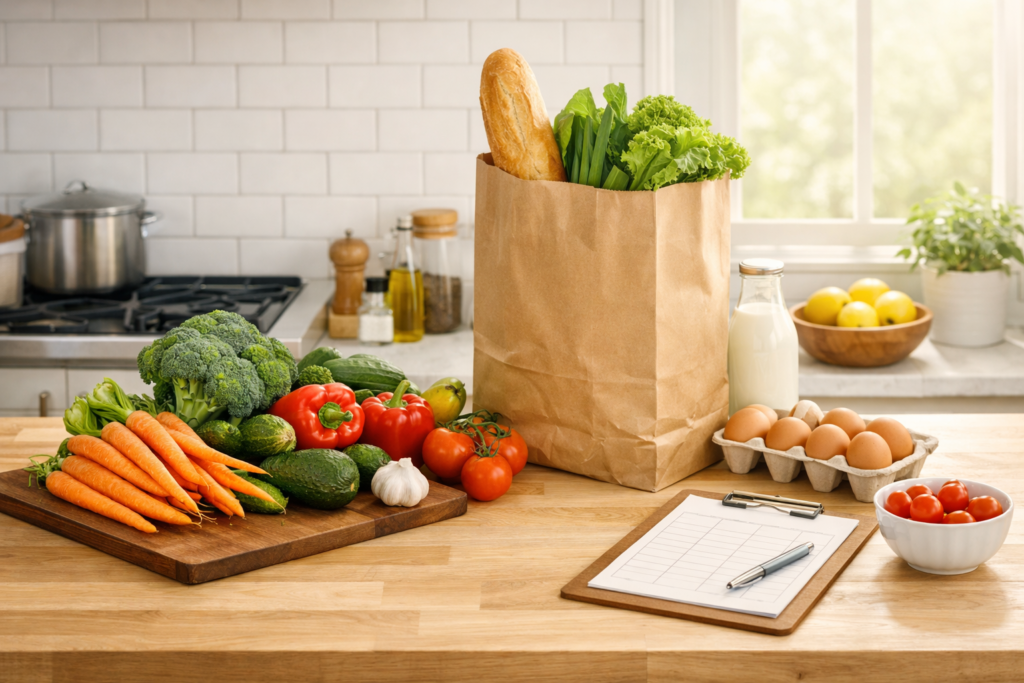
The average American family of four spends between $950 and $1,300 per month on groceries, depending on the USDA’s "moderate-cost" food plan estimates. That’s a wide range — and the difference between a family at the low end and the high end often has nothing to do with income. It has everything to do with a handful of shopping habits that either cost or save several hundred dollars a month without meaningfully changing what you eat.
I raised three kids on a federal employee salary, and groceries were the category where we either stayed on budget or blew it. The things that worked weren’t extreme couponing or a dramatic shift to off-brand everything. They were specific, repeatable habits. Here’s what they were.
Start With What You’re Actually Spending
Before you can cut anything, you need a real number. Not an estimate — a real number from your actual bank statements or credit card receipts over the last three months. Most families who think they spend $700 per month on groceries actually spend $950 or more when you include the Target run that included school supplies and a $60 grocery haul, the Costco trip charged to a different card, and the gas station snack runs that don’t feel like grocery spending but are.
Pull three months of statements, add up every transaction at a grocery store, club store, or food-related category, and divide by three. That’s your baseline. If you’re genuinely at $1,100 per month and want to get to $750, you need to identify where $350 is currently going — and it’s almost never what you expect.
Common hidden grocers in most families’ spending: Target food purchases, Amazon Fresh or Whole Foods orders billed as Amazon transactions, gas station food, drug store candy and drinks, and the frequent small stops ($12 here, $18 there) that individually feel trivial but add up to $80–$120 per month.
Meal Planning Is the Single Biggest Lever
There’s no way around this one. Families who meal plan consistently spend 20–30% less on groceries than families of the same size who don’t, according to multiple studies on grocery spending behavior. Not because planning is magical, but because it eliminates the two most expensive grocery habits: buying things you don’t use (food waste) and buying things you didn’t plan for (impulse purchases).
The implementation doesn’t have to be elaborate. A Sunday habit of writing down five to seven dinners for the week, listing the ingredients you need, checking what you already have, and building a shopping list from what’s missing. That’s it. The first time you do it, it takes 30 minutes. By the third week, it takes 10.
The financial mechanism is straightforward: when you go to the store with a specific list for specific meals, you buy what’s on the list. When you go without one, you estimate, you browse, you buy things that look good or seem like they might be useful, and you leave with $40 in items that either rot or go into a pantry you’ll forget about. Multiply that by four trips per month and you’ve found most of your $350.
Build a Predictable Protein Rotation
Protein is where grocery budgets get expensive fast — and where the most savings are available without sacrificing quality. The key is a rotation of five to six proteins that your family actually eats, that you buy in volume when on sale, and that anchor your meal planning week by week.
For most families, this means two or three chicken preparations (thighs are almost always cheaper per pound than breasts and more forgiving to cook), one ground beef or turkey dish, one egg-based dinner per week, and one legume-based meal (bean tacos, lentil soup, chickpea curry) that costs under $4 to prepare for four people and that most families can eat without complaint if it’s executed reasonably well.
Buying proteins when they’re on sale and freezing them is the move that reduces the most spending without changing what you eat. When chicken thighs go from $2.49 to $1.69 per pound, buy 10 pounds. When ground beef goes to $3.99 from $5.49, buy 8 pounds. This requires freezer space and the discipline to actually rotate and use what you’ve stored, but families who do this consistently report spending $60–$100 less per month on protein alone.
The Store Brand Tier System
Going all-generic across the board often produces quality compromises that undermine buy-in from the family and ultimately fail. A tiered approach works better:
Always buy generic: Flour, sugar, salt, rice, dried pasta, canned tomatoes, canned beans, oats, baking powder, spices, cooking oils, shredded cheese, butter, milk, eggs, bread (if your family eats store bread), most frozen vegetables, most boxed cereals. For these staples, the quality difference between store brand and national brand is typically negligible, and the savings are consistent — usually 20–40% less per unit.
Usually buy generic, test first: Yogurt, deli meat, crackers, condiments, laundry detergent purchased at the grocery store. Results vary by product and store — buy once, see if your family notices, decide from there.
Keep the name brand: The specific items your family has strong preferences about and actually eats less of when you switch. For most families this is a short list — a specific brand of peanut butter, a particular pasta shape, one or two condiments. This isn’t a moral failure; it’s recognizing that a $3 preference that prevents $200 in food waste is the better financial decision.
The Frequency Problem
Families that shop three or four times per week spend significantly more than families that shop once per week. This isn’t because three trips costs more per item — it’s because every trip includes unplanned purchases. The bread aisle detour, the sale display at the front, the "we’re already here" logic that results in $25 in extras on a trip that was supposed to be for milk.
Consolidating to one primary shopping trip per week (with a small supplemental run for produce or perishables if needed) reduces these incidental purchases substantially. For biweekly paycheck households, aligning the shopping trip with payday creates a natural budget structure — you know what you have, you plan for two weeks, you shop on a schedule rather than impulse. Our breakdown of budgeting on a biweekly paycheck covers the timing mechanics in detail — the same logic applies directly to grocery shopping rhythm.
The Produce Strategy That Actually Reduces Waste
Produce waste is the silent budget killer in most households. Families buy it with good intentions, half of it dies in the crisper drawer, and the emotional and financial cost of throwing out a $3 bunch of kale that went slimy makes people eventually stop buying fresh produce altogether — which costs more in the long run.
Two practical fixes. First, buy produce that fits your actual cooking plans for the week, not produce that represents aspiration. If you meal-planned five dinners and none of them include kale, don’t buy kale because kale is healthy. Second, buy some frozen produce deliberately. Frozen broccoli, peas, corn, spinach, and mixed vegetables are nutritionally comparable to fresh (often better, since they’re frozen at peak ripeness), cheaper per serving, and never go bad. A household that eats 60% fresh produce and 40% frozen typically wastes significantly less than one that commits to all-fresh.
Costco and Club Stores: The Math That Actually Works
Costco makes sense for a family of four specifically on a category-by-category basis, not as a general shopping solution. The items where the math works: paper goods (toilet paper, paper towels, tissues), olive oil, nuts and nut butters, large protein purchases (Costco’s rotisserie chicken at $4.99 is a legendary value), coffee, canned goods with long shelf lives, and non-food household items like detergent and trash bags.
The items where the math often doesn’t work: produce (you may buy twice what you’ll use, wasting the savings), specialty foods or items your family doesn’t eat regularly enough to get through the volume, and anything that goes stale or spoils before you finish the package.
The $65 annual Costco membership pays for itself if you save $6 per month versus buying those same items at a regular grocery store — which is easily achievable on paper goods and protein alone. But don’t let the warehouse atmosphere produce the same impulse-buying behavior that a regular grocery store does. The ticket prices are larger, so the waste is larger too.
The Grocery Budget Number That Actually Holds
For a family of four making consistent use of these strategies — meal planning, a protein rotation with freezer buying, strategic store brands, consolidated shopping trips, and disciplined produce buying — a sustainable grocery budget is roughly $650–$800 per month depending on your location and dietary needs. That’s $150–$300 below the average moderate-cost family food plan.
Getting from $1,100 to $750 in one month is unlikely. Getting there over three months, as you build the habits and figure out which specific changes work for your family, is realistic. The first month, focus on meal planning and reducing shopping frequency. The second month, add the store brand audit and protein freezer strategy. The third month, tighten the produce buying. By month four, the new spending level is the default rather than a discipline exercise.
When the savings start accumulating — even $100 extra per month — put them somewhere with intention rather than letting them dissolve into general spending. The right split between checking and savings covers exactly this: where to park cash that needs to be accessible but separate from your everyday spending. And if you’re tracking grocery spending alongside your broader household budget, a subscription audit is worth doing in the same sitting — most households have $50–$150 in forgotten recurring charges that, combined with grocery savings, can shift $200–$400 per month toward more intentional goals.
Tools That Help
A grocery price book — a simple spreadsheet or notebook where you track the regular and sale prices of items you buy frequently — is old-school and genuinely useful. When you know that chicken thighs at your store normally run $2.49/lb and you see them at $1.69, you know it’s worth buying extra. Without the reference, you’re guessing. Most families who do this for two months end up buying 70–80% of their protein on sale.
For meal planning itself, a magnetic notepad on the refrigerator beats any app for most households — low friction, visible, used by everyone. A magnetic meal planner and grocery list pad that sticks to the fridge is a $10 investment that genuinely changes the weekly planning habit for many families. And for the households that want to build a proper price book, a budget-focused family meal planning cookbook with built-in cost estimates per serving is more useful than a generic recipe collection — knowing that a dish costs $1.80 per serving before you decide to make it is different information than knowing it tastes good.