
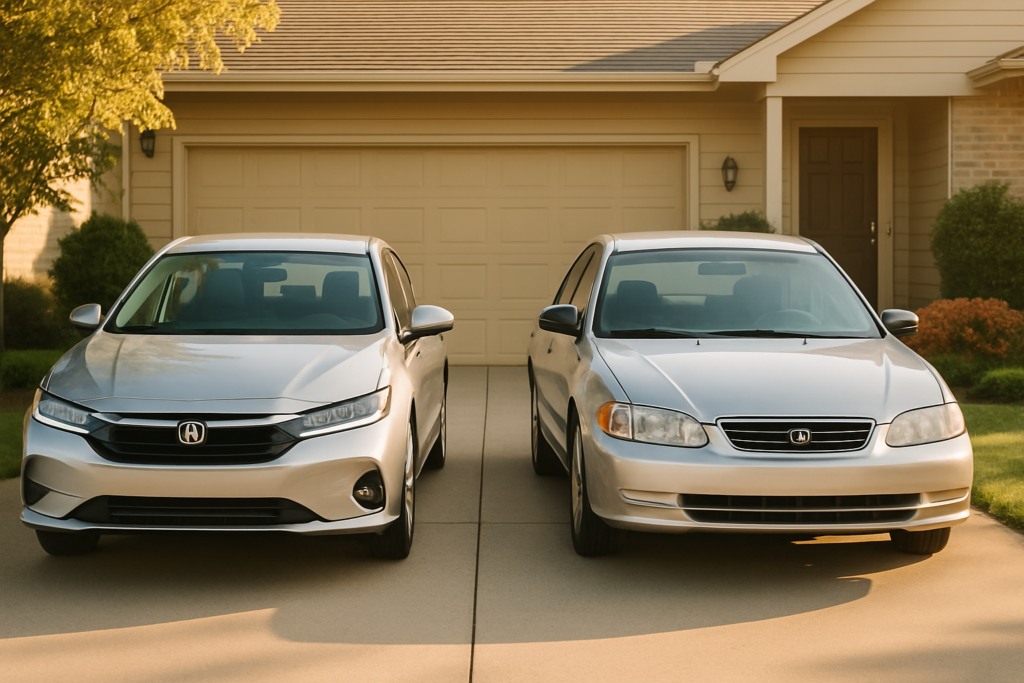
The average new car costs more than $48,000. That number is relevant even if you’re shopping for something far more modest — because it tells you where the market’s psychology is, and that psychology is working against you.
Here’s the counterintuitive truth: the least expensive time to own almost any car is not when you buy it new. It’s years two through seven, when the first owner has absorbed the steepest depreciation and you get to inherit a mostly-new vehicle at a significantly lower price. The person who buys a 3-year-old Honda CR-V didn’t get someone else’s problem. They got the same car at a $7,000 to $10,000 discount.
I learned this the hard way in my late twenties. I bought a brand-new sedan because it felt like the responsible, reliable choice — no worrying about what the previous owner did to it. What I didn’t calculate was the $6,000 I handed back to the universe in depreciation before the first oil change. I kept it nine years, which softened the blow. But I would have come out ahead buying a 2-year-old version of the same model. On a $55,000 salary, the difference between getting that call right and getting it wrong is real money — thousands of dollars that could be sitting in your savings instead of your monthly payment.
What New Cars Actually Cost You
New cars lose between 15 and 25 percent of their value in the first year. The exact number varies by brand and model, but even a vehicle that "holds its value" — like a Toyota Camry — will be worth $5,000 to $8,000 less than its purchase price twelve months after you drive it off the lot. That loss is yours the moment you sign.
Here’s what that looks like in real numbers:
- New 2025 Toyota Camry LE: approximately $29,500 to $32,000 depending on trim and market conditions
- A 3-year-old Camry LE with 30,000 to 45,000 miles: approximately $20,000 to $23,000
That’s an $8,000 to $10,000 price difference for functionally the same car with three years of use on it. The older Camry likely still has powertrain warranty coverage, runs the same engine, has the same safety features from that model year, and will give you the same commute experience at a meaningfully lower cost.
Run it through a 5-year loan at 7 percent interest:
- $30,000 financed: monthly payment of ~$594, total paid = $35,640
- $22,000 financed: monthly payment of ~$436, total paid = $26,160
That’s a $9,480 difference in total loan cost. Not a rounding error. And it doesn’t yet count the insurance difference.
How Insurance and Your Credit Score Change the Math
New cars cost more to insure. Lenders require full coverage — comprehensive and collision — on any financed vehicle, and insurers price that coverage against the vehicle’s replacement cost. A $30,000 new car carries a higher premium than the same model at a $22,000 used value. The difference typically runs $200 to $500 per year, sometimes more depending on your zip code and driving history. Over five years, that’s another $1,000 to $2,500 worth of consideration.
If you’re already weighing how much insurance you actually need, the decision about dropping collision coverage depends directly on what your car is worth versus what you’ve saved to replace it — and that math also comes into play as you choose between a new vehicle and a used one with a lower replacement value.
One more variable: used car loan rates are slightly higher than new car rates because lenders treat new vehicles as better collateral. If your credit score is in the 680 to 720 range, you might face a 2 to 4 percent higher interest rate on a used loan than on a new one. That partially offsets the purchase price savings, which is why your credit score should be in good shape before you finance anything. The interest rate gap between a 620 and 750 credit score on a $35,000 car adds up to thousands in total interest — the same principle applies on used vehicle financing.
What $55,000 in Salary Actually Leaves You to Spend on a Car
The standard guidance: keep your total monthly car cost — loan payment plus insurance — under 15 percent of take-home pay. At $55,000 per year, after federal taxes and a basic 401(k) contribution, you’re probably taking home somewhere between $3,500 and $3,800 per month. Fifteen percent is $525 to $570 total — payment and insurance combined.
If your insurance runs $140 per month on a used vehicle, your loan payment needs to land under $380 to $430 to stay within range. That’s tight but achievable on a $22,000 to $24,000 used vehicle with 10 to 15 percent down. It is functionally impossible on a new car at current prices and rates.
A $620 monthly car payment on a $54,000 salary is almost certainly too much — and the principles there apply equally at $55,000. The problem isn’t just cash flow. It’s the compounding cost of what you can’t do with that money: building an emergency fund, contributing to retirement, having any margin when something else goes wrong. A car payment that’s too high doesn’t just hurt your monthly budget. It boxes you in for five years.
When Buying New Actually Makes Sense
There are real scenarios where new is the right call. Don’t let anyone tell you it’s never justified.
You’re keeping it 10 or more years. If you drive 12,000 to 15,000 miles annually and hold the car for a decade, the depreciation curve flattens out. The warranty coverage on a new vehicle starts to pay for itself in avoided repair costs. Long holding periods close the gap.
You qualify for 0 percent financing. This appears occasionally on slow-selling models or during manufacturer promotions. At 0 percent, the investment-return argument for buying used loses its teeth — though only if the sticker price is genuinely competitive, not inflated to offset the rate deal.
The used market in your area is overheated. Used car prices can spike in tight regional markets, narrowing the typical discount to $2,000 to $4,000 instead of $8,000 to $10,000. Always check local prices before assuming the standard gap applies. If used vehicles are priced within 10 percent of new, the calculus shifts.
Outside those scenarios, the math favors used. Clearly and consistently.
How to Shop for a Used Car Without Getting Burned
Buying used well is a skill. Here are the non-negotiables.
Get a CarFax report. Not optional. Accident history, title issues, odometer discrepancies — it takes three minutes and costs less than $50. Skip it and you’re guessing.
Pay for a pre-purchase inspection. An independent mechanic (not the selling dealer’s shop) will check the vehicle for $100 to $150. That’s the best $100 to $150 in the used-car process. Period.
Run the OBD2 codes yourself. A Bluetooth OBD2 scanner costs $25 to $45 and plugs into any car’s diagnostic port. It reads stored and pending error codes — including ones a dealer may have cleared recently. Takes two minutes. Worth doing before you take a test drive.
Know the private party value before entering a dealership. CarMax’s instant offer tool gives you a real-world floor price for any vehicle — it’s what the market will actually pay. Walk in with that number and you negotiate from fact, not fiction.
If you want to understand the full range of tactics dealers use during a sale, a solid used-car buying and negotiation guide is worth reading before you step foot on a lot. The information is specific enough to save most readers more than the book costs within the first hour of negotiations.
The Bottom Line
On a $55,000 salary, buying a new car instead of a 3-year-old used version of the same model costs you roughly $9,000 to $14,000 more over five years when you account for the purchase price gap, total loan interest, and insurance. That’s not a minor lifestyle tradeoff. That’s a funded emergency fund. That’s a meaningful head start on a down payment. That’s three years of maxed-out HSA contributions.
The vehicle doesn’t know it’s new. Your commute doesn’t notice. Your budget absolutely does.
The recommendation: search certified pre-owned listings for 2- to 4-year-old vehicles with fewer than 50,000 miles. Budget for the mechanic inspection. Bring a CarMax offer to any negotiation. Keep total monthly car costs under 15 percent of take-home pay.
Before you go to any dealership, use Bankrate’s free auto loan calculator at bankrate.com/loans/auto-loans/auto-loan-calculator/ to run your specific price range against current rates and terms. Knowing your payment ceiling before you sit down with a salesperson is the single most useful thing you can do — it’s the difference between negotiating on your terms and reacting to theirs.