Debt and Credit

Learn how credit and debt work both for and against you.

Wide horizontal photo of a modern front door with a small welcome mat on a sunlit porch, bright cheerful daylight, no pe
Debt and Credit

Why Your Credit Karma Score Is Different From the Score Your Mortgage Lender Sees — and What the Gap Costs You at the Bank

Credit Karma shows 742. Your mortgage lender pulls 701. The loan officer explains — correctly — that the lender uses a different scoring model. You get the loan, but at a higher rate tier than you expected. The 41-point gap between the score you checked this morning and the score the bank used just added $87/month to your mortgage payment for 30 years. This is not a bug or a mistake. It’s the predictable result of checking a VantageScore when your lender uses FICO — two different mathematical models with different weightings that produce meaningfully different numbers for approximately 25% of consumers.


Wide horizontal photo of a man and a woman sitting together on a porch enjoying morning coffee, bright cheerful daylight
Debt and Credit

What’s the Best Age for Each Spouse to Claim Social Security When One Earned Much More Than the Other? The Married Couple Strategy That Can Add $1,900/Month

Most married couples don’t optimize Social Security — they both claim at 62 because it feels like getting money sooner, or both wait until 67 because someone told them to. But for a couple where one spouse earned significantly more than the other, the right strategy coordinates two very different claiming ages and can produce $1,900/month more household income than both claiming at 62. The math involves spousal benefits, survivor benefits, and one coordination rule most couples miss: the lower-earning spouse can’t claim the spousal benefit until the higher-earning spouse has already filed.

Wide horizontal photo of home renovation tools and paint swatches laid out on a bright sunny porch, warm cheerful light,
Debt and Credit

Personal Loan, HELOC, or 0% APR Credit Card: The True Cost of Financing a $15,000 Home Renovation at Today’s Rates

A $15,000 home renovation — new HVAC, kitchen appliances, bathroom remodel — financed the right way costs $0 to $1,372 in interest. Financed the wrong way for your situation, it costs $5,664. The three main options (personal loan, HELOC, and 0% APR credit card) each win in a specific scenario, and each is the wrong choice in others. Here’s the complete total cost comparison at 2024 rates, broken down by credit score range and payoff timeline.

Wide horizontal editorial photo of a pair of scissors resting beside a stack of credit cards on a light desk, bright nat
Debt and Credit

Does Your Employer Pay Off Student Loans? The $5,250 Tax-Free Benefit Most Workers With Student Debt Haven’t Checked For

Since 2020, employers have been able to pay up to $5,250 per year toward employees’ student loans — completely tax-free on both sides. That’s a benefit worth $6,825 in gross equivalent value to someone in the 22% federal bracket once you factor in payroll taxes avoided. As of 2024, roughly 1 in 10 large employers offers this benefit, and the number is growing. Most employees with student debt have never checked whether their company is one of them. Here’s how to find out, what to do if your employer offers it, and how to advocate for adding it if they don’t.

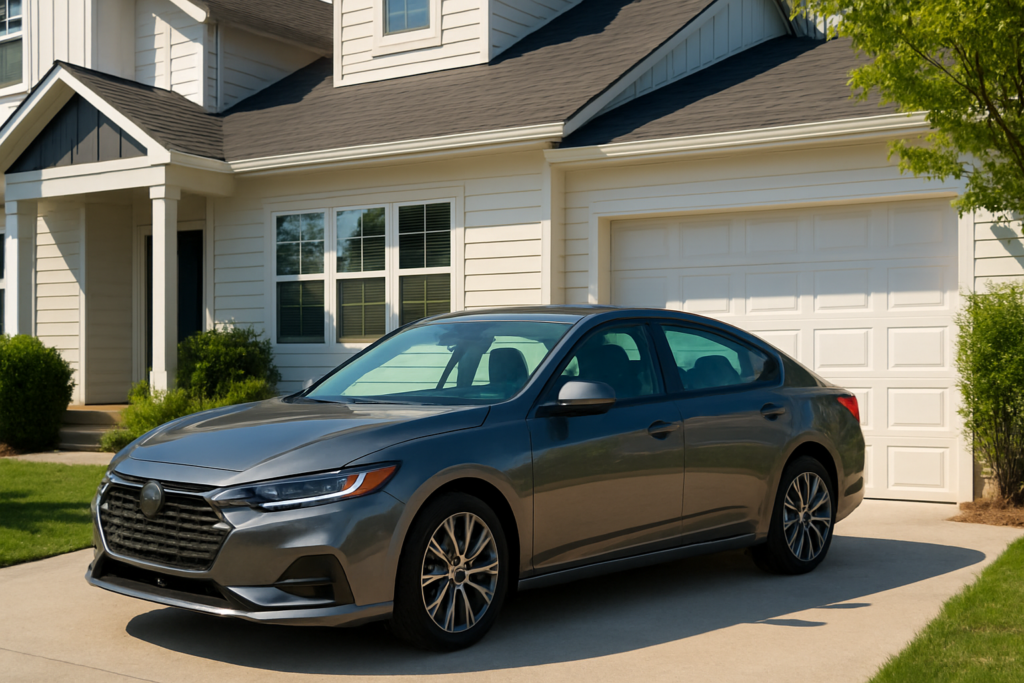
Wide horizontal photo of a modern, late-model sedan parked in a bright sunny driveway of an attractive home, clean dayli
Debt and Credit

Is Leasing or Buying a $35,000 Car the Better Financial Decision? The True 5-Year Cost Comparison Most Dealers Don’t Show You

Leasing a $35,000 car looks like the smarter move when the monthly payment is $395 vs $554 to buy it. But that comparison omits the mileage penalty most Americans will trigger, the disposition fee at lease end, the perpetual payment cycle with zero equity, and what happens when you hold a purchased car past the loan payoff date. Here's the full 8-year total cost math for leasing vs buying a $35,000 car — including the break-even point where buying becomes the clear financial winner.

Wide horizontal photo of an attractive well-kept suburban home with a covered porch, bright sunny daytime, clean landsca
Debt and Credit

Should I Use My Extra $600/Month to Pay Off $40,000 in Student Loans at 6.5% or Save for a House Down Payment?

A 28-year-old with $40,000 in student loans at 6.54% and $15,000 already saved toward a $250,000 house faces one of the most common financial forks in the road: accelerate student loan payoff or build the down payment? The math produces three distinct strategies with outcomes that differ by $28,000 in total cost over 10 years. The right answer depends on your local home prices, your PMI estimate, and one question most people forget to ask: what happens to the student loan if you lose your job?

Wide horizontal photo of a modern front door with a small welcome mat on a sunlit porch, bright cheerful daylight, no pe
Debt and Credit

How Much Does PMI Cost Per Month on a $350,000 Home With 5% Down, and When Does It Actually Cancel?

On a $350,000 home with 5% down and a 740 credit score, private mortgage insurance adds approximately $140-160 per month to your payment — and at normal amortization on a 7% mortgage, you'll pay it for roughly 10-11 years before the loan balance naturally reaches 80% of the original purchase price. But most homeowners don't know they can request cancellation the moment home appreciation pushes their equity to 20%, and many eliminate PMI 4-6 years early by doing exactly that. Here's the full cost breakdown and the formal cancellation playbook.

Wide horizontal photo of a man and a woman walking together through a bright sunlit park, cheerful retirement-age couple
Debt and Credit

Which Account Should I Withdraw From First at 62: My 401k, Roth IRA, or Taxable Brokerage Account?

The order you draw down retirement accounts matters almost as much as how much you've saved. A 62-year-old couple with $500,000 in a traditional 401k, $200,000 in a taxable brokerage, and $150,000 in a Roth IRA who draws from the wrong accounts first can pay $40,000-80,000 more in lifetime taxes than an identical couple who sequences withdrawals correctly. The conventional wisdom — taxable first, then traditional, then Roth — is right in broad strokes but misses the Roth conversion window and the 0% capital gains rate that can dramatically improve the outcome.

Wide horizontal photo of an attractive well-kept suburban home with a covered porch, bright sunny daytime, clean landsca
Debt and Credit

How Much More Does a 620 Credit Score Cost vs a 760 on a $300,000 Mortgage Over 30 Years?

A 760 credit score and a 620 credit score can both get approved for a $300,000 mortgage in today's market. The difference is what you pay for it. At current rates, the gap between a 760 and a 620 score on a 30-year fixed mortgage translates to roughly $469 more per month — and $168,000 more in total payments over the life of the loan. That's not a rounding error. It's a second mortgage on a small house. Here's the full breakdown by loan size, plus the 18-month roadmap to move from 620 to 700+.

Wide horizontal photo of a man and a woman sitting together on a porch enjoying morning coffee, bright cheerful daylight
Debt and Credit

Should I Convert My $200,000 Traditional IRA to a Roth at 58, and How Much Can I Convert Each Year Without Jumping Tax Brackets?

The years between when you retire and when you start taking Social Security are often the lowest-income years of your adult life — and the best window you'll ever have to convert a traditional IRA to a Roth at a low tax rate. A married couple with no income in the 58-62 window can convert up to $123,500 per year and stay entirely in the 12% bracket. Here's the exact math, the bracket-filling strategy, and why NOT converting could cost you tens of thousands in avoidable taxes after 73.

Scroll to Top